AstroForge builds AI control system for 2027 deep-space mission
In brief
- Autonomy-1 is a transformer-based AI system enabling autonomous deep-space navigation without Earth contact.
- DeepSpace-2 spacecraft will test the system in 2027, launching late 2026 with electric propulsion.
- Deep-space communication delays of minutes to hours necessitate onboard autonomous decision-making.
- Radiation-hardened microcontrollers and NVIDIA Jetson flight computers power navigation and autonomy.
- AstroForge targets platinum-group metal mining reconnaissance and technology demonstration.
How Deep-Space Autonomy Works
Radio signals travel at the speed of light, yet at deep-space distances that still means delays of several minutes to potentially hours, depending on orbital geometry. This latency makes it impossible for ground operators to pilot a spacecraft in real-time. A probe must make critical navigation and course decisions on its own.
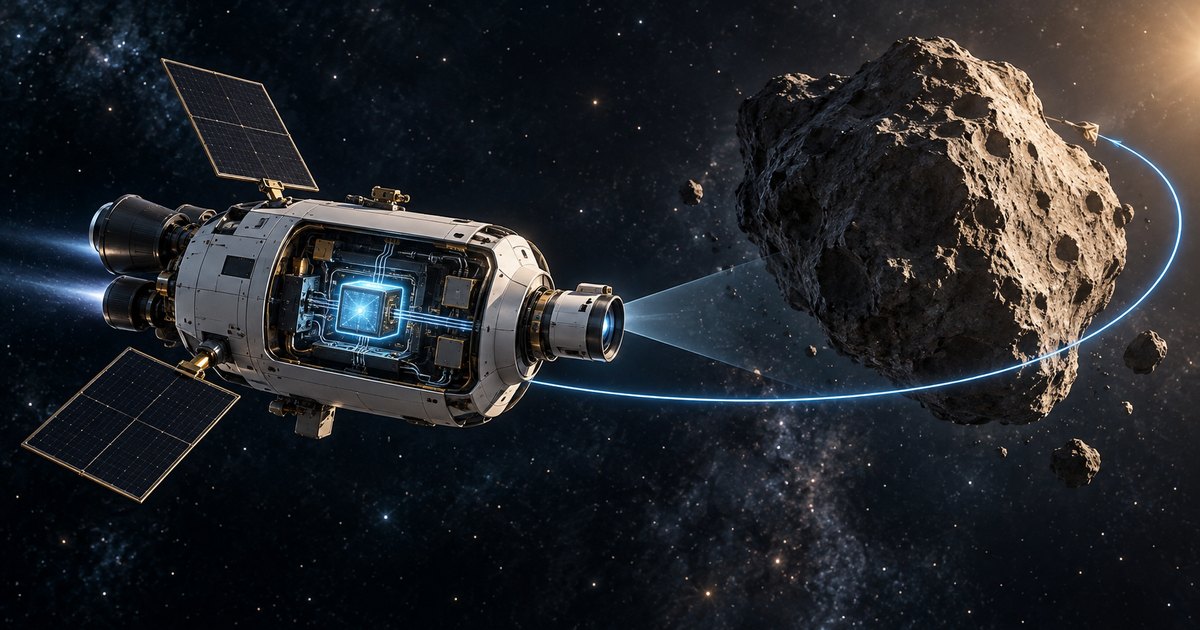
The Autonomy-1 system uses a small, transformer-based AI model, the same architectural family behind large language models, adapted to manage navigation, tracking, and decision-making aboard a space probe without waiting for a signal from Earth. The system isn't a general-purpose AI — it's purpose-built for the specific constraints of deep-space flight.
AstroForge's onboard compute stack uses radiation-hardened SAMRH71 microcontrollers for core flight functions, where reliability matters most, and an NVIDIA Jetson AGX Xavier Industrial flight computer for perception and guidance work. Radiation hardening is essential; solar radiation and cosmic rays can corrupt standard electronics in space.
The 2027 Test Mission
AstroForge was founded in January 2022 by Matthew Gialich and Jose Acain. The company's first spacecraft, Odin, launched in February 2025 but encountered early issues with solar arrays and communications systems that cut the mission short.
DeepSpace-2, a roughly 200-kilogram spacecraft equipped with electric propulsion, is scheduled to launch in late 2026. It will carry the Autonomy-1 system into deep space. A reconnaissance mission planned for mid-2027 would use hyperspectral imaging to characterize near-Earth objects, specifically M-type asteroids.
Mining the Asteroids
AstroForge believes M-type asteroids contain commercially extractable platinum-group metals. Platinum-group metals, which include platinum, palladium, iridium, and others, are used extensively in catalytic converters, electronics, and fuel cells.
AstroForge's near-term missions are reconnaissance and technology demonstration, not extraction. The 2027 flight will focus on proving that Autonomy-1 can reliably navigate and gather data in deep space. Extraction comes later, if the technology and the market case both hold up.