Mirrored tabletop drops two AI robot controllers to zero in block-stacking trials
In brief
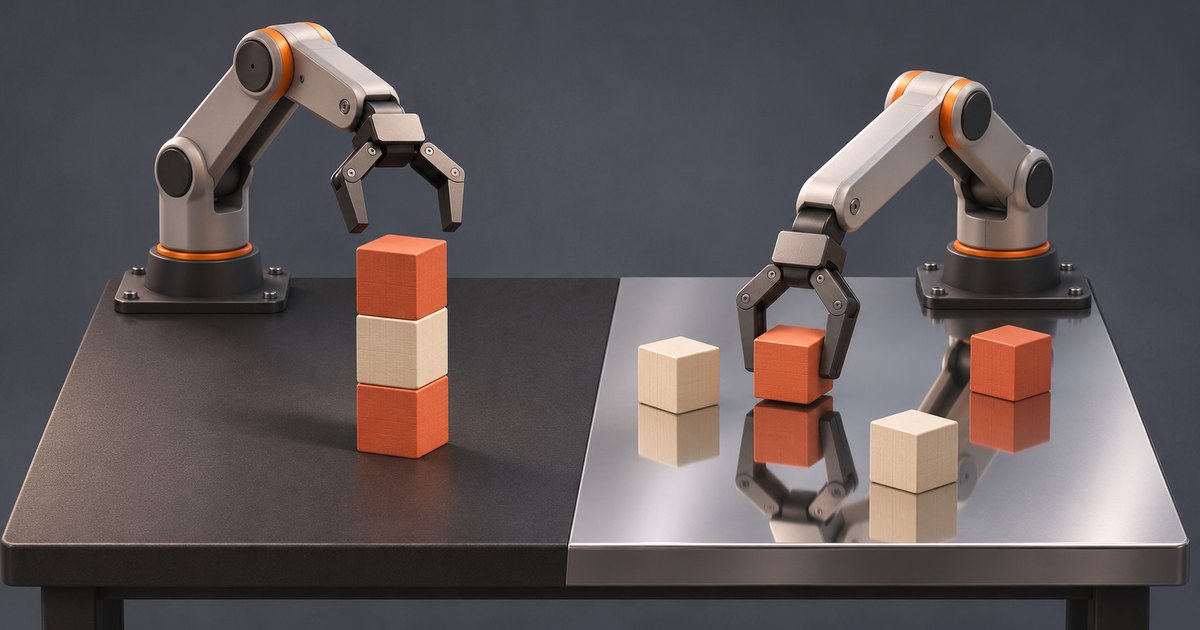
- Two AI robot controllers stacked blocks in eight of ten attempts on a regular work surface.
- Both controllers went zero for ten on a mirrored tabletop, per a Peking University preprint.
- The Nov. 24 preprint hasn't been peer reviewed, and each test cell used just ten trials.
- Researchers said robot behavior was consistent with attempts to reach a reflection.
What the trials measured
The researchers tested two controllers, π0.5 and FastWAM, on four tasks: placing produce, stacking blocks, flipping a bracket and inserting a cylinder. The same Franka arm ran every physical trial, and each controller kept the same camera setup, instructions and execution budget in every condition. Each one attempted every task ten times per condition (five starting layouts, run twice each). A third condition put a mirror upright beside the workspace.
For block stacking, Table 6 of the preprint reports 80% and 0% for each controller, with ten trials per cell.
Ten trials isn't a big sample.
Across the physical trials, π0.5 succeeded in 77.5% of trials without a mirror, 52.5% with the upright mirror and 27.5% with the mirrored tabletop. FastWAM's rates were 60%, 30% and 10% in those same conditions. (The team compared each controller with its own mirror-free baseline because the two had different execution budgets, so these numbers aren't a head-to-head ranking.)
Simulation and the obstacle question
The team's RoboDojo-Mirror benchmark tested five controllers in simulation across eight shared tasks. Every controller's overall success rate fell with a single upright mirror, with two mirrors and with a mirrored tabletop.
An upright mirror is also an obstacle, though. To account for that, the researchers ran a simulated comparison using nonreflective panels of the same shape and placement. Across 120 pairs comparing two upright mirrors with two matching panels, WALL-OSS succeeded only with the panels in 25 pairs and only with the mirrors in two. For Awomo-0.5, the counts were 42 and three across its own 120 pairs. Mirror trials still failed more often in the subset where the robot had succeeded in the mirror-free baseline and touched neither test surface.
Reaching for a reflection?
In one simulated tube pickup, the gripper closed away from the tube and lifted empty-handed. The team also looked at pairs where the robot touched the surface in both trials, succeeded with the panels and in the baseline, and then failed with the dual mirrors. In those pairs, it spent a greater share of the trial touching the mirrors than the panels.
That comparison covered six matched pairs for WALL-OSS and seven for Awomo-0.5. The researchers said the pattern was consistent with attempts to reach a reflection, which is careful wording (it's not presented as a confirmed cause). The findings apply only to these controllers, on this setup, at these sample sizes.
Frequently asked questions
How many trials did the Peking University mirror study run?
Each controller attempted every physical task ten times in each condition, using five starting layouts twice each. Table 6 of the preprint reports block-stacking success of 80% and 0% for each controller, with ten trials per cell.
Was the mirror just acting as a physical obstacle?
The researchers tested this in simulation using nonreflective panels of the same shape and placement. Across 120 pairs, WALL-OSS succeeded only with the panels in 25 pairs and only with the mirrors in two. Awomo-0.5's counts were 42 and three. Mirror trials still failed more often even when the robot touched neither test surface.
Why did the robots fail around mirrors, according to the researchers?
In matched pairs where the robot failed with dual mirrors but succeeded with panels, it spent a greater share of the trial touching the mirrors. The comparison covered six pairs for WALL-OSS and seven for Awomo-0.5. The researchers said the pattern was consistent with attempts to reach a reflection.