Palmer Luckey reveals SLAB seastead, pitches offshore base for industry and medicine
In brief
- Palmer Luckey revealed SLAB, a proposed seastead with a 1,000-year design life, in an X post.
- Proceeds from Facebook's 2014 Oculus acquisition financed the project, Luckey said.
- Luckey wrote that he and friends cashed it up at a $1B valuation in 2017.
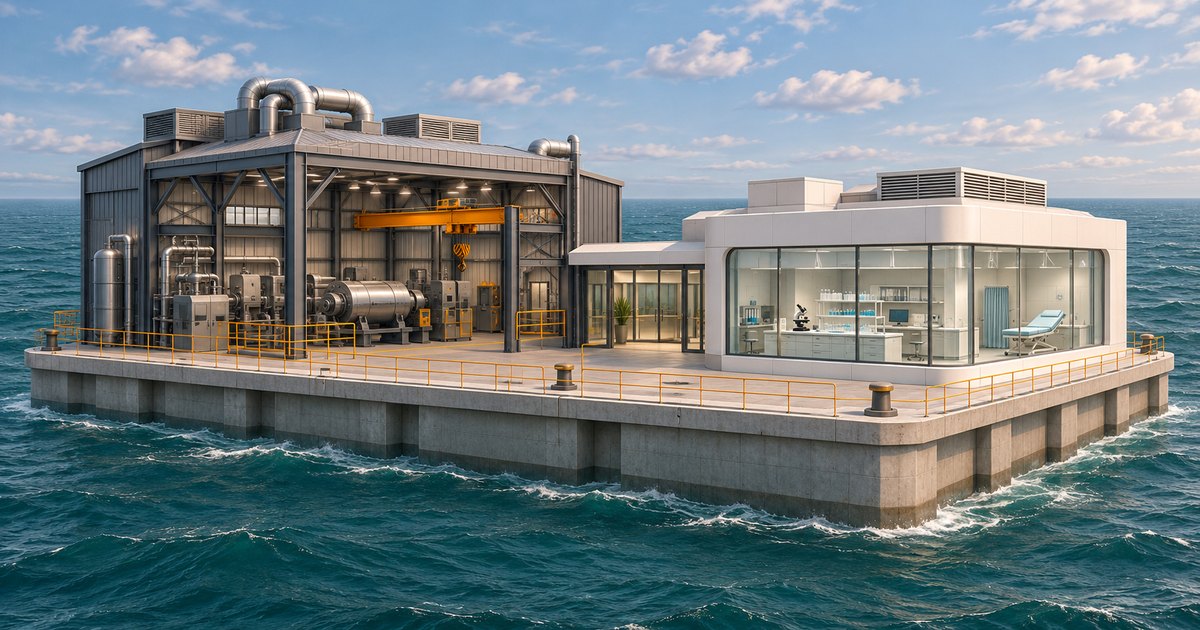
- Only an AI-generated illustration was released, with no photos of an operating facility.
- NOAA guidance describes a 12-nautical-mile territorial sea and a 200-nautical-mile exclusive economic zone.
What Luckey says SLAB is for
Luckey wrote that selling Oculus to Facebook in 2014 gave him money for helicopter flight lessons and for developing SLAB. He's apparently been working on the idea for nearly a decade, according to Decrypt.
His stated goal is an industrial base that's cheaper than land and free from state and local laws he believes are crippling critical American industries. Luckey framed it as a way to strengthen the U.S. rather than escape it (he called it a "relief valve" for outdated regulations).
"Me and a few close friends cashed it up at a $1B valuation back in 2017, and while it still has a long way to go, there has been significant progress towards my goal of reviving manifest destiny and westward expansion"
There aren't any photos of a working facility. The announcement came with an AI-generated illustration of a large offshore platform. Luckey said he went public after learning journalists were preparing to describe SLAB as a floating AI data center, a framing he rejected as incomplete because the project is considerably older and "way cooler than that."
The 'illegal medicine' exchange
Luckey gave a more specific sense of his ambitions in an exchange with journalist Joshua Topolsky, who questioned whether an offshore community was a sensible way to modernize medical research. Topolsky argued reform could happen without building an island and challenged Luckey to name rules that had kept him from pursuing medical advances.
Luckey replied that he'd rather build a place where people could save their families with "safe but currently illegal medicine ASAP" than wait for lawmakers to reform the system. He accused political interests and large pharmaceutical companies of obstructing change, arguing that conventional reform would need legislation able to win support from 60 senators.
Where U.S. jurisdiction ends
Moving an operation into the ocean doesn't automatically place it outside American jurisdiction, Decrypt noted. When an X user asked how close SLAB could operate to San Francisco without falling under its jurisdiction, Luckey's reply was short.
"Three miles."
That generally corresponds to the boundary of California's state-controlled coastal waters, according to the U.S. Bureau of Ocean Energy Management. Federal reach goes further, though. NOAA guidance describes a 12-nautical-mile territorial sea and a 200-nautical-mile exclusive economic zone where the U.S. retains authority over certain economic activities and artificial islands.
The rules that apply would depend on SLAB's location, whether it floats or is attached to the seabed, and how it's registered. Even vessels on the high seas remain subject to maritime law and the jurisdiction of their flag states.
Frequently asked questions
What is Palmer Luckey's SLAB project?
SLAB is a proposed seastead with a 1,000-year design life that Luckey revealed in an X post. He said it could support industries from metal processing and oil refining to medical research and treatment. The only image released was an AI-generated illustration, not a photo of an operating facility.
Would SLAB be outside U.S. law if it sat three miles offshore?
Not necessarily. Three miles generally marks California's state-controlled coastal waters, according to BOEM. NOAA guidance describes a 12-nautical-mile U.S. territorial sea and a 200-nautical-mile exclusive economic zone where the U.S. retains authority over certain activities and artificial islands. The rules would depend on SLAB's location, structure and registration.