Polymarket assigns 22% odds to Bab el-Mandeb Strait closure by 2026
In brief
- Polymarket traders assign 22% probability to effective Bab el-Mandeb closure by December 31, 2026.
- Ship transits have declined 40–60% from pre-crisis levels, currently averaging 15 vessels daily.
- War-risk insurance premiums spiked to 0.7–2% of hull value; over $1 million per large container ship voyage.
- Qatar warned closure would devastate global energy markets and liquefied natural gas shipments.
- Houthi forces control Perim Island, Hanish islands, and Mokha port, leveraging the waterway.
The stakes: 12% of global trade hangs in the balance
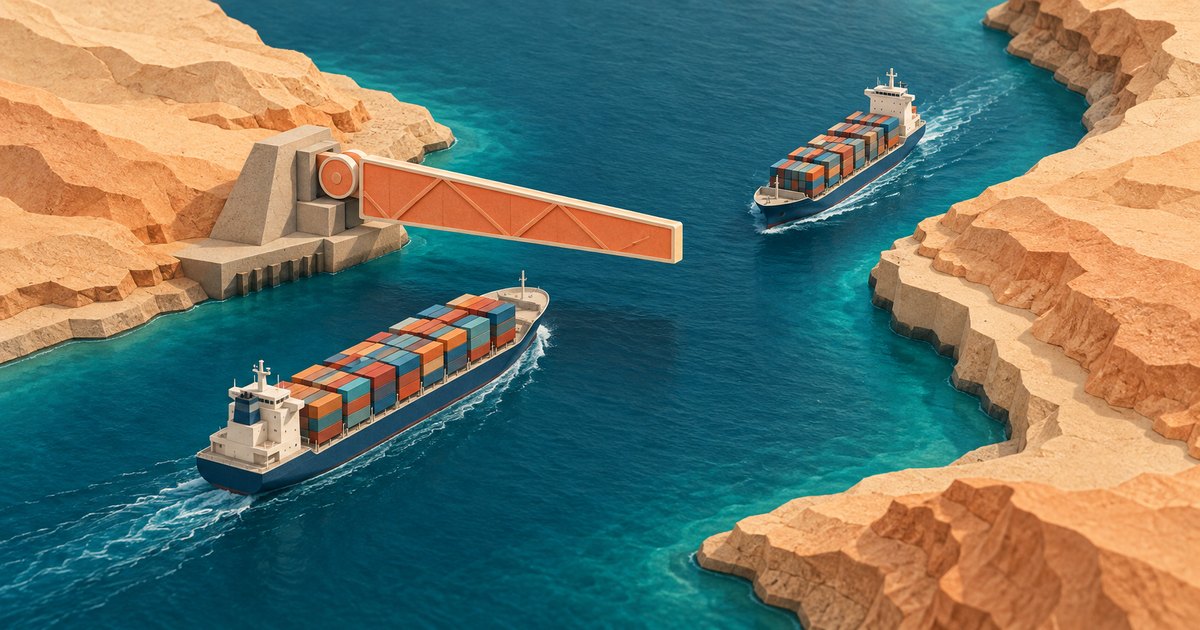
Roughly 12% of global trade normally passes through this strait. When it slows, everything from oil tankers to container ships must take the long way around Africa—a detour that adds roughly 10-14 days to voyages between Asia and Europe. The economic friction alone reshapes shipping costs and delivery timelines worldwide.
Current ship transits have already dropped dramatically, with daily crossings at roughly 15 vessels, representing a 40-60% decline from pre-Houthi targeting levels. That's not yet an effective closure under Polymarket's definition—but it's close. The market's probability has fluctuated between 21% and 33% in recent weeks, signaling trader uncertainty as military developments unfold.
Houthi territorial gains shift the calculus
In September 2026, Houthi forces captured the port of Mokha, a strategic Yemeni coastal city that gave them direct line-of-sight over the waterway. They also took control of Perim Island and the Hanish islands, volcanic outcroppings that sit in the middle of the strait itself.
When Houthi forces seized Perim Island, the Polymarket contract repriced within hours. This isn't idle speculation—it's capital responding to material shifts in military control. The Houthis have maintained that they are not imposing a blanket closure, saying navigation remains open to vessels they don't consider hostile. But the gap between that stated position and an effective closure—whether by accident, escalation, or deliberate blockade—is what traders are now pricing.
The insurance and energy shock
War-risk insurance premiums for transiting the strait have spiked to between 0.7% and 2% of hull value. For a large container ship worth hundreds of millions of dollars, that translates to per-voyage insurance costs that can easily exceed a million dollars. These aren't theoretical numbers—they're baked into shipping decisions right now.
Energy markets face even sharper exposure. Qatar has publicly warned that an effective closure of the Bab el-Mandeb would constitute a catastrophe for global energy markets. The strait is a critical artery for liquefied natural gas shipments heading from the Persian Gulf to European and Asian buyers. A sustained disruption would ripple through power grids and industrial supply chains across two continents.
Market mechanics: how prediction markets price geopolitical risk
Polymarket allows traders to buy and sell outcome shares that pay $1 if a specified event occurs. A 22-cent share price translates directly into a 22% implied probability. Total market volume across related contracts on Polymarket has landed in the range of $5 million to $14 million, indicating genuine capital commitment.
The contract's resolution date of December 31, 2026 gives traders about three months of remaining exposure. That's a tight window—long enough for military postures to shift, short enough to concentrate risk into a near-term decision point. The market isn't predicting closure is likely. It's pricing it as plausible enough to warrant hedges and positioning.