TakeMe2Space launches India's first orbital computing satellite on SpaceX
In brief
- TakeMe2Space launches MOI-1A, India's first orbital computing satellite, on SpaceX Transporter-18 on October 1, 2026.
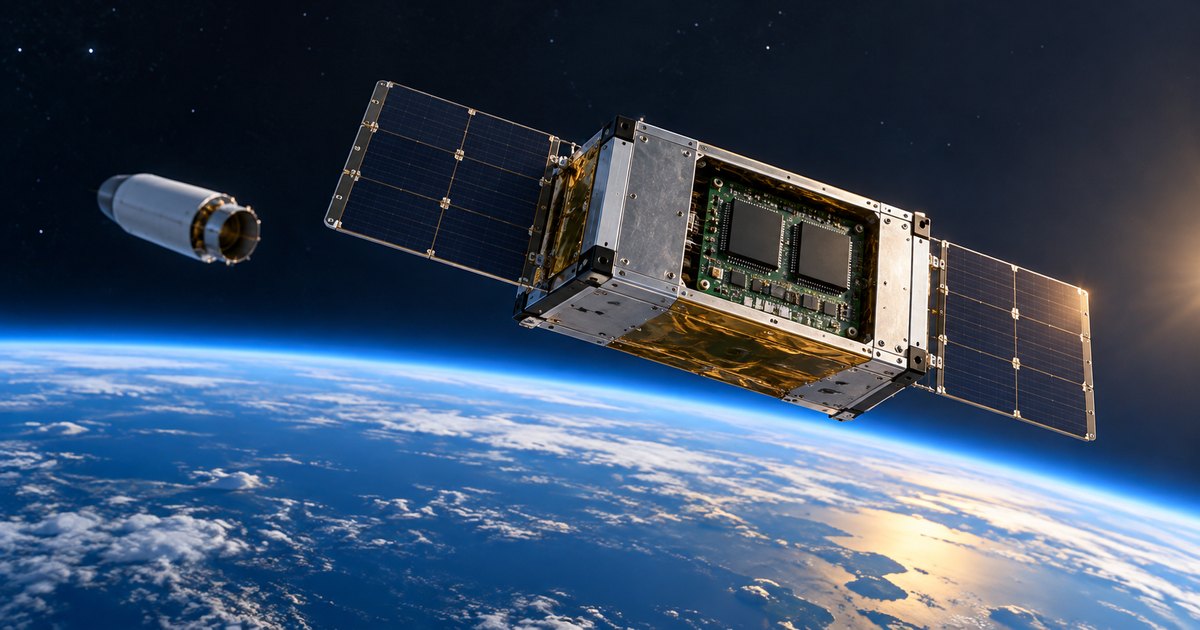
- MOI-1A is a 6U CubeSat with Nvidia Orin NX processors capable of 117 trillion operations per second and a 9-band multispectral imager.
- The satellite already has 23 customers from GIS, agriculture, mining, insurance, and education sectors.
- TakeMe2Space plans a constellation delivering 50 kilowatts of orbital computing capacity by 2029 with Generation-2 satellites launching around 2027.
The satellite and its hardware
MOI-1A is a 6U CubeSat weighing under 50 kg, equipped with Nvidia Orin NX edge-computing processors capable of delivering 117 trillion operations per second. The compact design runs on a power budget of roughly 150 watts. The satellite features a 9-band multispectral imager for Earth observation and 2 TB of onboard storage, allowing it to process imagery directly in orbit rather than transmitting raw data back to Earth.
TakeMe2Space founder Ronak Samantray has framed MOI-1A not as a data center in space but as a compact edge-computing node. Instead of beaming massive raw datasets back to Earth for processing, customers upload AI models to the satellite and get only refined insights sent back down.
From setback to launch
The company's path to this October launch includes both proof and loss. TakeMe2Space flew a technology demonstration payload on an ISRO PSLV mission in December 2024, validating core systems in orbit. But the original MOI-1 satellite was lost in January 2026 when the PSLV-C62 launch failed. Operating on approximately $5 to $5.6 million in seed funding, the startup chose to rebuild and book a ride on SpaceX's rideshare instead of waiting for another ISRO slot.
Customer traction and future plans
The satellite already has 23 customers lined up, spanning geographic information system firms, agricultural companies, mining operations, insurance providers, and educational institutions. This early demand validates the edge-computing-in-orbit thesis. TakeMe2Space's ambitions extend well beyond MOI-1A. The company is targeting Generation-2 satellites with 1,500 watts of compute capability and 100 TB of storage each, with deployment starting around 2027. The long-term vision involves building a constellation that delivers 50 kilowatts of orbital computing capacity by 2029.
To reach that scale, the startup is developing supporting technologies including radiation-hardened components, advanced power systems, star trackers, and optical inter-satellite links. Each of these systems must survive the vacuum and radiation of low Earth orbit while delivering consistent performance. The October 2026 launch will be the first real test of whether TakeMe2Space's edge-computing model can scale beyond the lab.