UK sanctions A7 crypto network for processing $90 billion for Russia

In brief
- UK Foreign, Commonwealth & Development Office sanctioned A7 and 18 entities on May 26 for Russian sanctions evasion.
- A7 network, founded October 2024, is Kremlin-backed with majority stake held by Israeli-Moldovan oligarch Ilan Shor.
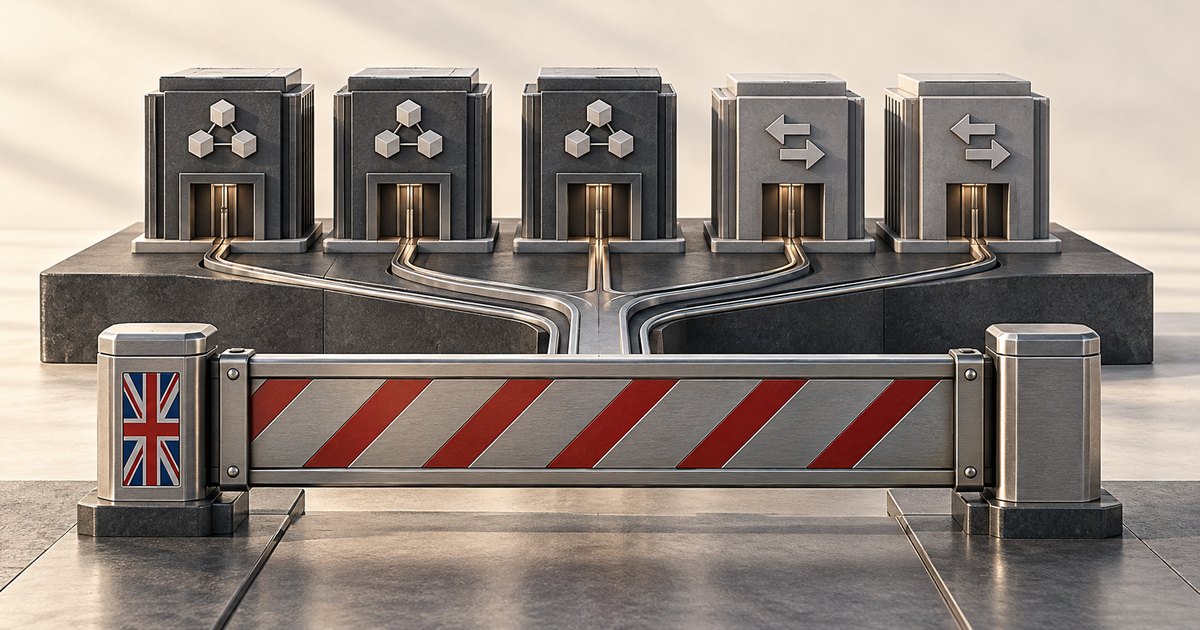
- UK applied Regulation 17A to crypto exchanges for first time, a tool previously reserved for sanctioned banks.
- A7 processed over $90 billion in 2025; its ruble-backed stablecoin A7A5 handled $93.3 billion in transactions.
A banking-level sanction on crypto
The UK applied Regulation 17A of its Russia sanctions regime to crypto exchanges for the first time, a tool previously reserved only for sanctioned banks. The regulation requires all UK financial firms to freeze funds and sever correspondent relationships with designated entities. This marks a significant escalation: Western regulators have treated crypto networks as financial intermediaries worthy of banking-level enforcement rather than as peripheral money-movement channels.
The primary target was the A7 network, described by the UK government as a system built to bypass Western sanctions, finance military procurement, and process revenue from Russian oil exports. The network's ownership structure reveals a tangled web of sanctioned and unsanctioned actors. Ilan Shor, an Israeli-Moldovan oligarch convicted in 2017 for his role in the theft of $1 billion from three Moldovan banks, holds the majority stake. Promsvyazbank, a Russian state-owned bank sanctioned in 2022, holds the minority stake.
Scale and expansion
The UK government says the A7 network claimed to have moved more than $90 billion in 2025 alone. Chainalysis independently reported similar figures: A7A5, the ruble-backed stablecoin serving as A7's primary settlement rail, processed $93.3 billion in transactions in under a year. These numbers suggest a financial operation of extraordinary scale, rivaling some national payment systems.
A7 has also expanded into Lagos and Harare, opening offices in Nigeria and Zimbabwe as part of a broader push into jurisdictions with weaker regulatory oversight. Vladimir Putin attended a virtual ribbon-cutting ceremony when A7 opened a physical branch in Vladivostok in September 2025, signaling state-level backing.
The broader sanctions picture
Western governments spent three years building what they believed was an airtight financial blockade around Russia, severing its banks from SWIFT, freezing sovereign reserves, and barring major institutions from clearing dollar transactions. Yet A7's emergence suggests that crypto networks, stablecoins, and private payment rails have created new pathways that traditional sanctions architecture wasn't designed to address.
According to the UK government's official statement, the broader sanctions effort since 2022 has stripped more than $450 billion from Russia's economy. Still, Russia's Economy Ministry this month cut its 2026 growth forecast from 1.3% to just 0.4%, suggesting the economy remains under pressure despite new evasion channels. The UK's decision to treat crypto networks like banks signals a recognition that financial containment now requires regulators to move as fast as the networks themselves.
Frequently asked questions
What is the A7 network?
A7 is a Kremlin-backed financial system founded in October 2024, designed to help Russia bypass Western sanctions and finance military procurement. It processes transactions through a ruble-backed stablecoin called A7A5 and has claimed to move over $90 billion in 2025 alone.
Why did the UK sanction A7 using banking regulations?
The UK applied Regulation 17A, a tool previously reserved only for sanctioned banks, because A7 functions as a financial settlement system rather than a simple crypto platform. This marks the first time the UK has treated a crypto network as a banking entity under its sanctions regime.
Who owns and operates A7?
Ilan Shor, an Israeli-Moldovan oligarch convicted in 2017 for stealing $1 billion from Moldovan banks, holds the majority stake. Promsvyazbank, a Russian state-owned bank sanctioned in 2022, holds the minority stake. Putin attended A7's opening in Vladivostok in September 2025.