Vitalik Buterin: Local AI protects privacy, but wallet security needs stronger rules
In brief
- Local AI models now handle most tasks on high-end laptops without exposing full personal context to remote servers
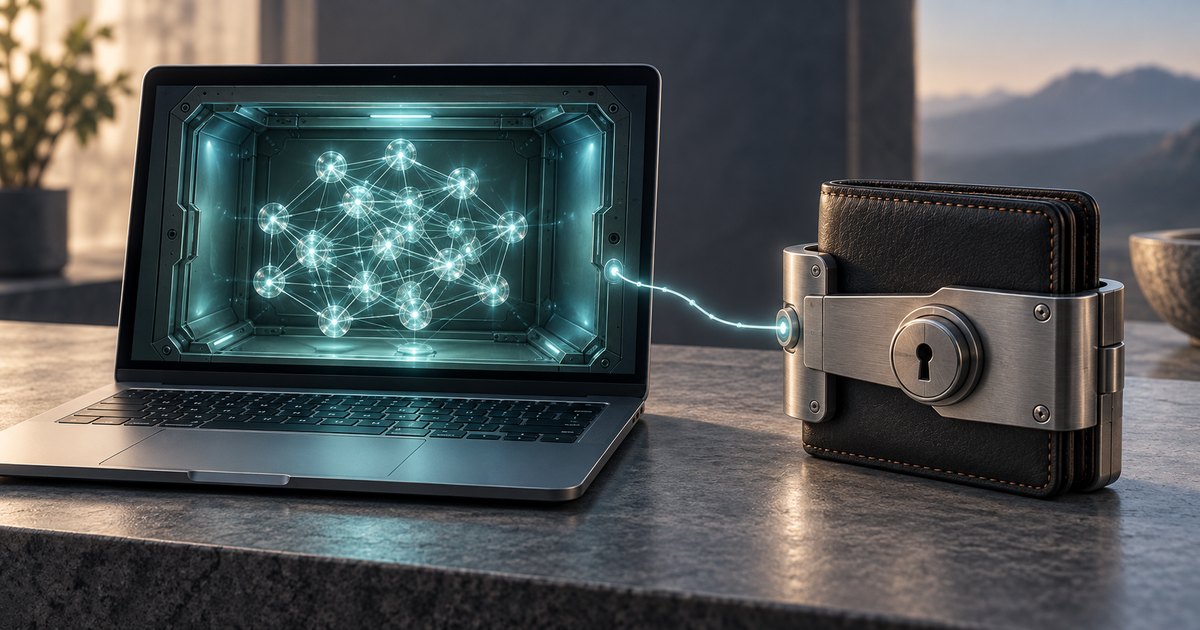
- Local models act as intelligent routers, deciding when to send requests to stronger systems while withholding sensitive data
- Wallet software requires much higher security standards before AI can safely control crypto assets, Buterin cautioned
Local models gain practical speed
Buterin stated on September 17 that Qwen 3.8 Flash and recent improvements in llama.cpp had brought local models close to handling a large share of tasks on his Strix Halo laptop. Benchmark data showed input-processing rates ranging from 109.82 to 373.22 tokens per second, while output generation ranged from 18.42 to 33.37 tokens per second—fast enough for interactive use.
This represents a shift from his April assessment. In that earlier account, Buterin described Qwen3.5:35B as capable of handling bounded tasks and familiar programming work, while advanced independent agents remained beyond laptops' practical reach. His September assessment changed that calculus, with a local model no longer appearing limited to transcription, summarization, or other tightly bounded work.
Privacy through selective routing
In the newer description, a local model can become the main interface for a larger share of activity and decide when a remote model is necessary. A remote service receives only the question or context the local model selects, rather than every file, message, and wallet detail.
This architecture addresses a core privacy concern. Users retain control over what information leaves their device. The local model acts as a gatekeeper, filtering requests before they reach cloud services. Buterin described a local model coordinating requests to stronger remote systems while withholding the user's full personal context for more advanced work.
Wallets still need higher bars
Yet Buterin drew a sharp line on one critical application: wallet security. "Wallet software still needs a much higher bar before it can hand an AI control over crypto assets," he cautioned.
Benchmark figures support a practical claim about responsiveness on one high-end laptop but leave model judgment, resistance to malicious instructions, and transaction authorization unanswered. The speed gains don't address whether a model can reliably refuse harmful requests or whether users can trust it with fund transfers. Local inference can improve privacy while the power to move funds remains behind separate, enforceable controls, Buterin noted, implying that AI and transaction authority must stay decoupled.
The Ethereum Foundation's recent work reflects this caution. In its second-quarter allocation update, the Ethereum Foundation listed Steward, a fully local macOS smart-account wallet, suggesting active interest in privacy-first wallet design—though still without delegating asset control to AI agents.