Deep Green secures £200M for AI data center heat-recovery expansion
In brief
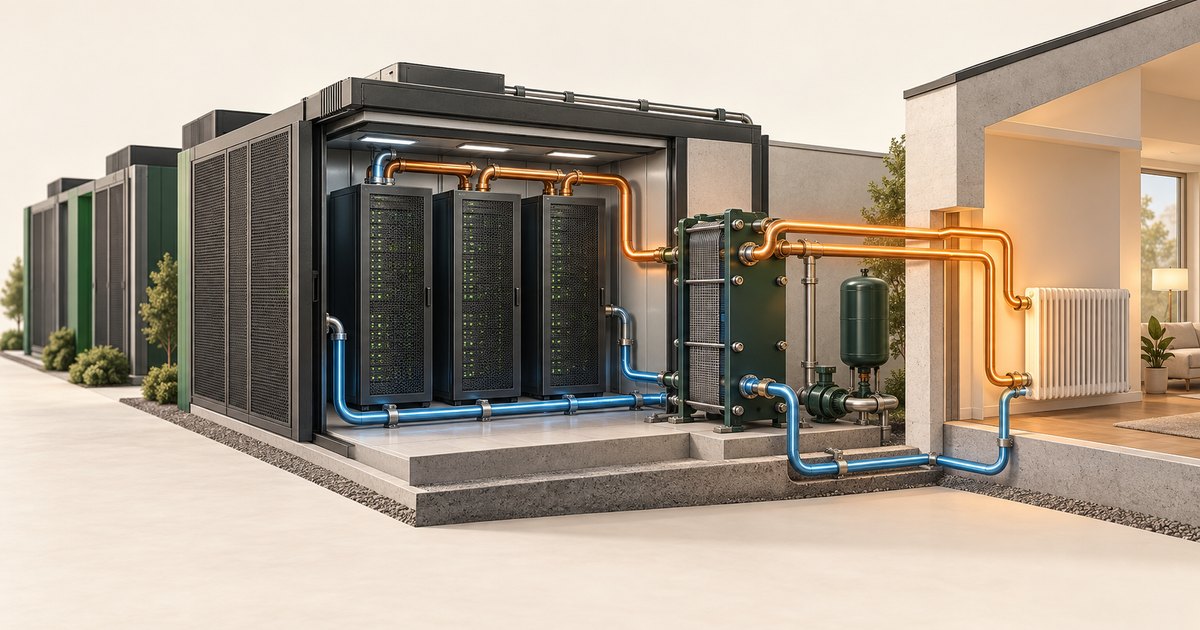
- Deep Green's closed-loop, waterless cooling systems capture and reuse up to 95% of waste heat from AI data centers.
- Bradford facility (5.6 MW) secured planning consent in May 2026 and will cut CO2 emissions by over 4,500 tonnes annually.
- £200M investment from Octopus Energy Generation funds deployment of 300 MW heat-reusing infrastructure across UK, Ireland, Europe, and North America.
Proof of concept in action
Deep Green's proof of concept facility in Urmston, Greater Manchester is a 400 kW installation that pipes excess heat directly to Trafford Leisure Centre's swimming pool. The arrangement saves the facility roughly £80,000 per year in heating costs while cutting CO2 emissions by an estimated 100 to 150 tonnes annually. The system achieves a Power Usage Effectiveness rating between 1.03 and 1.07—a metric where lower is better, and industry standards typically hover around 1.5.
Deep Green's Energy Reuse Factor ranges from 82% to 93% across its facilities, measuring how much waste heat actually gets put to productive use. This isn't theoretical. It's working, now, in a real swimming pool in Greater Manchester.
Scaling the model
Deep Green's 5.6 MW facility in Bradford secured planning consent on May 14, 2026 and is expected to connect to the Bradford Energy Network. Once commissioned by late 2028, the facility is projected to reduce CO2 emissions by more than 4,500 tonnes per year.
The company claims its modular colocation facilities can become operational in as little as four weeks, compared to traditional data center construction timelines that stretch into years. Speed matters when AI infrastructure demand is accelerating.
CEO Mark Lee has described the philosophy as a commitment to "use the electrons twice." That's the core of it.
Funding and expansion
Deep Green has secured £200 million in investment from Octopus Energy Generation. The funding supports the company's ambition to deploy 300 MW of heat-reusing data center infrastructure across the UK, Ireland, Europe, and North America.
Timing aligns with regulatory pressure. The EU's revised Energy Efficiency Directive, which took effect in 2024, requires new data centers above 1 MW to report energy performance metrics and explore waste heat reuse opportunities. Deep Green's model doesn't just comply—it turns waste into revenue and environmental benefit in the same move.