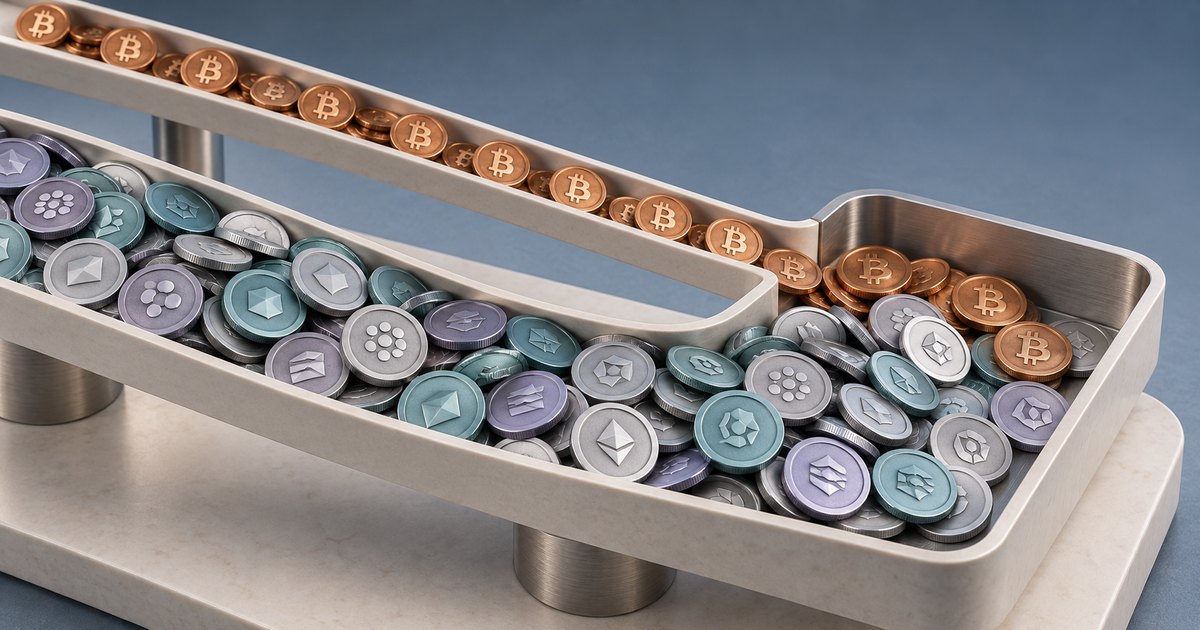
Ethereum order-book depth falls to 35–45% of Bitcoin's, CoinGecko data shows

In brief
- Ethereum's depth fell to 35–45% of Bitcoin's, down from above 60% a year ago, per CoinGecko.
- Ethereum's median depth sits at $13 million to $14 million across eight centralized exchanges.
- Bitcoin's median depth reached $29 million bid and $37 million ask, about 50% above 2025.
- Bitcoin's order books deepened while Ethereum's stayed roughly flat in absolute terms.
- The depth gap now affects how large trades are structured, Crypto Briefing says.
Bitcoin pulled ahead
Bitcoin's median aggregate depth reached $29 million on the bid side and $37 million on the ask side, roughly 50% higher than the 2025 figures, per the same CoinGecko analysis. That's the detail that explains most of the move.
Did Ethereum's liquidity dry up? By this measure, it didn't. According to Crypto Briefing, Bitcoin's liquidity improved substantially while Ethereum's stayed roughly flat in absolute terms, and that combination is what dragged the ratio down. The publication described a market structure that's been shifting steadily rather than breaking in a single moment.
The ratio fell because Bitcoin got deeper, not because Ethereum got thinner.
How the data was measured
The analysis measured order-book depth at about 0.15% from the mid-price, across eight major centralized exchanges. That scope matters. The 35–45% figure describes near-price liquidity on those venues (it isn't a reading of every market where ETH trades), and LeoDex News hasn't reviewed the underlying dataset.
Binance led liquidity for both assets among the exchanges studied. MEXC sat at the other end, with liquidity of roughly $450,000, which the report called a clear outlier in the dataset.
What it means for large trades
Crypto Briefing pointed to growing institutional interest in Bitcoin, partly channeled through spot exchange-traded products, as one plausible driver of the deeper Bitcoin books. It didn't present that as a confirmed cause. Ethereum has its own spot ETFs, but the publication said it hasn't seen the same kind of commitment show up in the order books.
Ethereum, despite its own spot ETF approvals, has not attracted the same scale of order-book commitment.
The practical angle is execution. In the publication's view, the gap between the two assets is now wide enough to influence how large trades get structured, and algorithmic and institutional traders will need to account for Ethereum's shallower book when they size and route orders. That's analysis, not a measured outcome, but it's the part of the data that desks moving size in ETH can't really ignore.
Frequently asked questions
Why did Ethereum's liquidity ratio to Bitcoin fall?
According to Crypto Briefing's coverage of CoinGecko data, Bitcoin's liquidity improved substantially while Ethereum's stayed roughly flat in absolute terms. Bitcoin's median depth reached $29 million bid and $37 million ask, about 50% above 2025 levels, which pushed the ratio down.
How was market depth measured in the CoinGecko analysis?
The analysis measured order-book depth at about 0.15% from the mid-price across eight major centralized exchanges. On that basis, Ethereum's median depth was $13 million to $14 million, or 35–45% of Bitcoin's.
Which exchanges had the most and least liquidity?
Binance led liquidity for both Bitcoin and Ethereum among the eight exchanges studied. MEXC had liquidity of about $450,000, which the report described as a clear outlier in the dataset.