Four Gemini 4 Argon agents beat Minecraft's Ender Dragon in 27 hours, DeepMind says
In brief
- Four Gemini 4 Argon agents beat the Ender Dragon in 27 hours and 14 minutes.
- The agents wrote 2,783 JavaScript programs, sent 229 messages and died 605 times.
- The run cost an estimated $520 based on API pricing, or $1,040 at standard rates.
- The test ran on Easy difficulty, using code-based Mineflayer access rather than visual play.
- Researchers said the result doesn't show the skills carry over to real-world tasks.
How the agents played
The agents didn't use a keyboard. They didn't watch the screen either. Each one controlled a character through Mineflayer, an open source JavaScript library that lets programs interact with the game, and the agents wrote code to navigate, gather resources, craft equipment and fight enemies. The world was a randomly generated survival map set to Easy difficulty.
Within the first ten minutes, they'd started dividing responsibilities among themselves. The team kept a shared memory of locations, strategies and lessons from earlier failures, and built 42 reusable helper functions for movement, resource collection and survival. One agent tracked two Eyes of Ender to work out where a hidden stronghold was. Its estimate landed within 43 meters of the actual portal room.
605 deaths and ten crystals
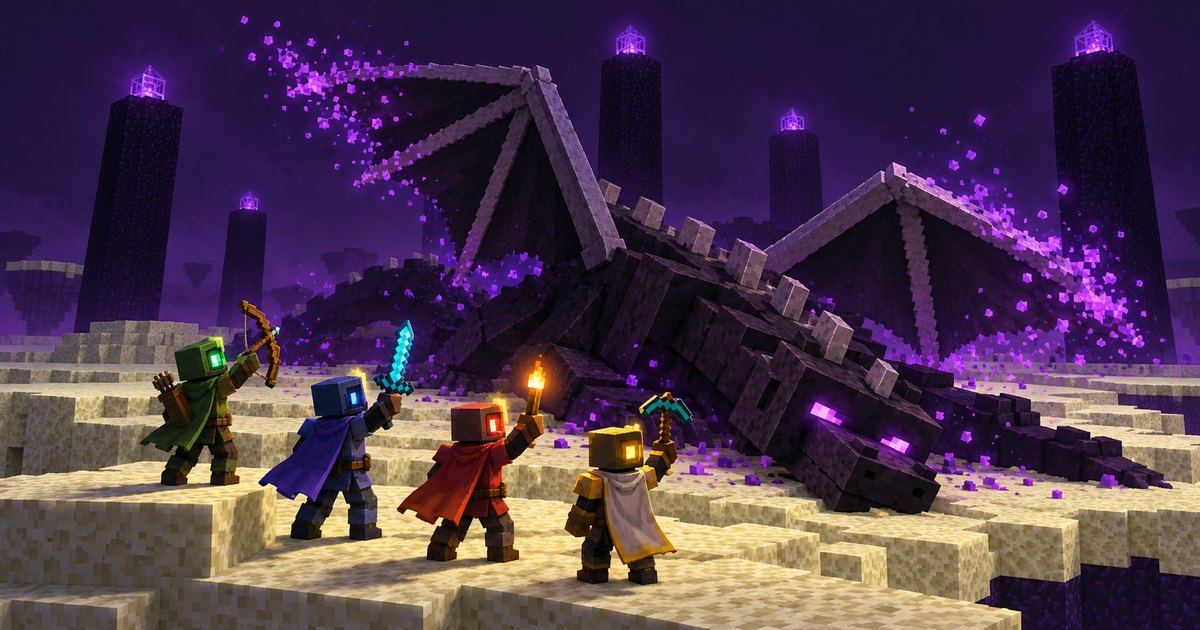
The End was where things got hard. The dragon kept killing members of the team until the agents identified ten crystals that restored its health, then stacked dirt blocks to reach and destroy them before finishing off the boss.
According to the paper, the agents wrote and executed 2,783 JavaScript programs, exchanged 229 messages and died 605 times along the way. The full run took 27 hours and 14 minutes (six server restarts included), and the four agents generated roughly 63,313 lines of JavaScript between them.
The compute bill is real too. The researchers said the agents processed about 1.35 billion input tokens and generated 16 million output tokens across roughly 24,000 model calls. Based on Gemini 4 Argon's introductory API pricing, that put the estimated cost at approximately $520, or $1,040 at standard pricing.
DeepMind called it the first known autonomous end-to-end completion of Minecraft by general purpose AI agents without custom gaming tools or predetermined world configurations.
What it doesn't prove
The researchers argued the experiment shows capabilities that matter for complex software engineering and enterprise workflows. They're also upfront about the limits. The result came from a controlled gaming environment on Easy difficulty, using programmatic access to game information rather than visual interaction, and the paper doesn't establish whether those capabilities would transfer directly to real-world environments.
Frequently asked questions
How did the Gemini 4 Argon agents play Minecraft without a keyboard?
Each agent controlled a character through Mineflayer, an open source JavaScript library that lets programs interact with the game. The agents didn't use a keyboard or read the screen. They wrote code to navigate, gather resources, craft equipment and fight enemies, and built 42 reusable helper functions along the way.
How much did it cost for the AI agents to beat Minecraft?
The researchers said the agents processed about 1.35 billion input tokens and generated 16 million output tokens across roughly 24,000 model calls. Based on Gemini 4 Argon's introductory API pricing, the estimated cost was approximately $520, or $1,040 at standard pricing.
Does the Minecraft result mean AI agents can handle real-world tasks?
Not yet, by the researchers' own account. The run took place in a controlled gaming environment on Easy difficulty and used programmatic access to game information rather than visual interaction. The researchers acknowledged that the experiment doesn't establish whether the capabilities would transfer directly to real-world environments.