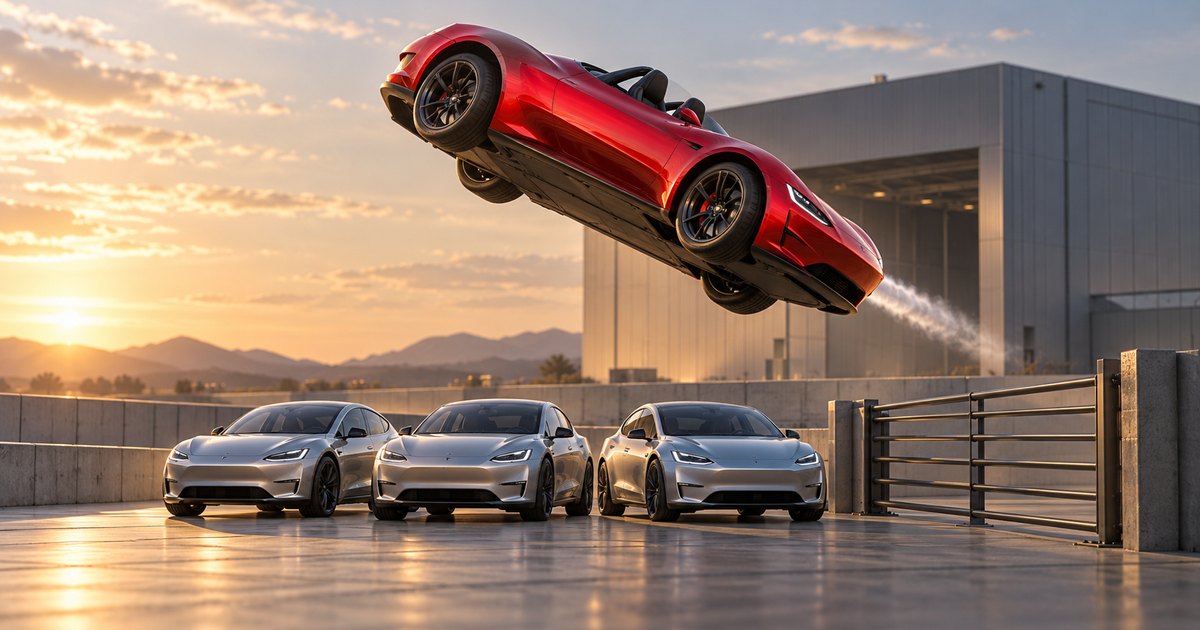
Tesla Roadster flips midair at SpaceX demo; flying Rocket not road-approved
In brief
- Tesla's new Roadster flipped in midair and jumped a row of Teslas on October 15.
- Cold-gas thrusters fed by compressed air, not rocket fuel, power the flight trick.
- Tesla's reservation page lists $50,000 and $250,000 versions with a $5,000 deposit.
- The single-seat Rocket is invite only, has no listed price and isn't road-approved.
- Musk said Rocket production begins in 2028.
How it flies
At the same event the car also hopped over a row of Teslas, with a Semi truck in the lineup. Sam Altman praised the car on X.
It doesn't burn rocket fuel. The flight comes from cold-gas thrusters, which blast compressed air out of nozzles. Lars Moravy, Tesla's vice president of vehicle engineering, said 10 thrusters connect to 600 liters of compressed air and that Tesla borrowed some of the technology from SpaceX. Musk had told Joe Rogan the previous October that the next Roadster could be capable of flight.
Tesla's numbers
These are Tesla's on-paper figures, as reported by Decrypt. The company says the car tops 230 mph, gets more than 300 miles of range and hits 0-60 mph in under a second. The on-stage run clocked 0.81 seconds (Tesla lists the single-seat Rocket at under 0.59).
Tesla hasn't announced a price for any version. Its reservation page asks $50,000 for the two-seat Performance and $250,000 for the Thrust, with $5,000 due up front and the balance within 10 days. The Rocket, built around the full flight system, has no listed price at all.
The approval gap
Tesla's own website says the flying version isn't approved for public road use. When Musk was asked whether it's street legal:
he said it “depends on your street.”
According to Decrypt's reporting, no FAA or road-safety approval for the car has been reported. U.S. carmakers self-certify that their vehicles meet federal safety standards, but an aircraft needs an FAA airworthiness certificate, and the FAA says certifying a new aircraft type can take five to nine years. One precedent Decrypt points to is Alef Aeronautics, whose Model A precursor got an experimental airworthiness certificate for flight testing in June 2023. State law is patchy too. Minnesota's "Jetsons law" lets residents own a roadable aircraft but bans taking off and landing on public roads, and it followed a 2020 New Hampshire law on flying car ownership.
Then there's physics. A 2021 paper in Joule found an electric aircraft needs 500 to 900 watts per kilogram to hover, compared with 150 to 350 in cruise. Decrypt said Tesla's cold-gas approach sidesteps that problem, which is likely why the demo featured jumps and a flip rather than a trip from one place to another.
The demo showed jumps, not travel.
Frequently asked questions
How does the Tesla Roadster Rocket fly?
The car uses cold-gas thrusters, which blast compressed air out of nozzles instead of burning rocket fuel. Tesla engineering VP Lars Moravy said 10 thrusters connect to 600 liters of compressed air and that Tesla borrowed some technology from SpaceX.
Is the flying Tesla Roadster street legal?
Tesla's website says the flying version isn't approved for public road use, and Musk said it "depends on your street." Decrypt reported that no FAA or road-safety approval for the car has been reported.
How much does the new Tesla Roadster cost?
Tesla hasn't announced official pricing. Its reservation page asks $50,000 for the two-seat Performance and $250,000 for the Thrust, with $5,000 due up front. The single-seat Rocket has no listed price and is invite only.