FutureBit's fruit fly brain model projects 10x Bitcoin mining efficiency
In brief
- FutureBit tested simulated fruit fly brain for Bitcoin mining via HashFly web browser experiment
- HashFly simulation uses 2,914 neural pathways from adult male fruit fly brain model
- Biological neurons could achieve 1 watt per terahash, 10x more efficient than 3nm ASICs
- Current HashFly experiment runs on conventional hardware, cannot compete with real miners
- FlyMiner project uses 139,255 fruit fly neurons to control standard mining software
The HashFly Experiment
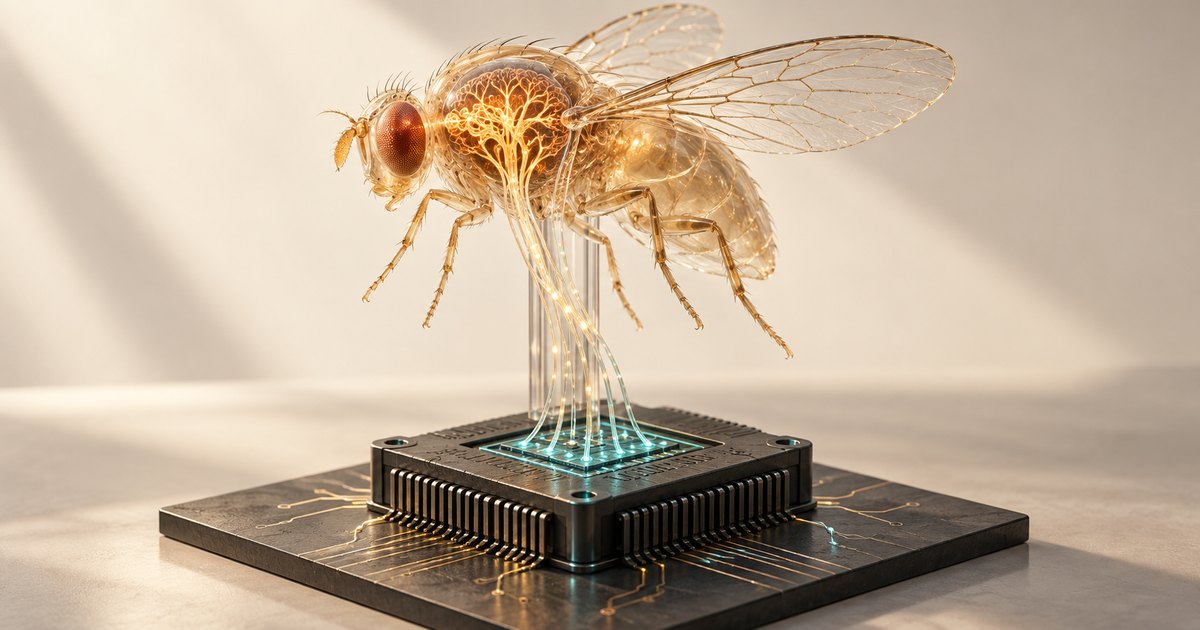
FutureBit's HashFly demonstration simulates activity across 2,914 neural pathways taken from the fruit fly brain model. While the current version runs on conventional computer hardware, it lacks the hash rate and difficulty required to compete with actual Bitcoin miners. Yet the theoretical implications are striking.
FutureBit projects that if scaled on real organic neurons, the system would hash at approximately 1 watt per terahash—achieving 10 times the efficiency of the best silicon 3nm ASICs. A hypothetical mining system made with living neurons could perform one trillion calculations per second while consuming about one watt of electricity.
"Fun fact if this could be scaled on real organic neurons, it would hash at ~ 1 watt per terahash...10x the efficiency of the best silicon 3nm ASICs!" FutureBit stated in its documentation.
Competing Brain-Based Approaches
A separate project called FlyMiner uses a digital map of 139,255 fruit fly neurons and 16.8 million connections to control a standard Bitcoin mining program. When simulated signals from the fly's movement-control neurons reach a set threshold, the program tests possible solutions at speeds of up to 700,000 attempts per second.
For context, FutureBit's five-inch Apollo III ASIC miner reaches 18 terahashes per second—vastly outpacing both brain-inspired experiments in raw throughput.
Mining's Expanding Frontier
Bitcoin mining continues to attract unconventional approaches. In March 2021, an IT security researcher converted a 1989 Nintendo Game Boy into a Bitcoin miner that produced about 0.8 hashes per second. A Brooklyn bathhouse said in June 2023 that it was routing heat from mining equipment into its pools. Utah-based Nodal Power raised $13 million in August 2023 to expand facilities that generate electricity from landfill methane and use some of that power to mine Bitcoin.
These experiments reflect a broader industry focus on efficiency and alternative energy sources, even as they remain far from practical deployment at scale.
Frequently asked questions
How does the fruit fly brain model work for Bitcoin mining?
HashFly simulates 2,914 neural pathways from MaleCNS v1.0, a digital model of an adult male fruit fly's brain. The simulation runs on conventional computer hardware but lacks the hash rate to compete with real miners. A separate FlyMiner project uses 139,255 fruit fly neurons and 16.8 million connections to control standard mining software.
Why would biological neurons be more efficient at mining?
FutureBit projects that a biological system could hash at approximately 1 watt per terahash, achieving 10 times the efficiency of the best silicon 3nm ASICs. A hypothetical mining system made with living neurons could perform one trillion calculations per second while consuming only about one watt of electricity.
Is the HashFly experiment actually mining Bitcoin?
No. The experiment runs on conventional computer hardware and lacks the hash rate and difficulty required to compete with Bitcoin miners. It remains a theoretical demonstration rather than a practical mining operation.