Hyperliquid's first $14.58M USDC yield payment awaits transfer for HYPE buybacks
In brief
- About $14.58 million in USDC yield was pending transfer to Hyperliquid's Assistance Fund, per Crypto Briefing.
- AQAv2 sends roughly 90% of net yield on USDC reserves to HYPE buybacks and burns.
- Validators approved AQAv2 on June 12, 2026, with 69.08% support.
- Total annual buyback capacity from fees plus yield is above $900 million, Crypto Briefing estimates.
How AQAv2 routes the yield
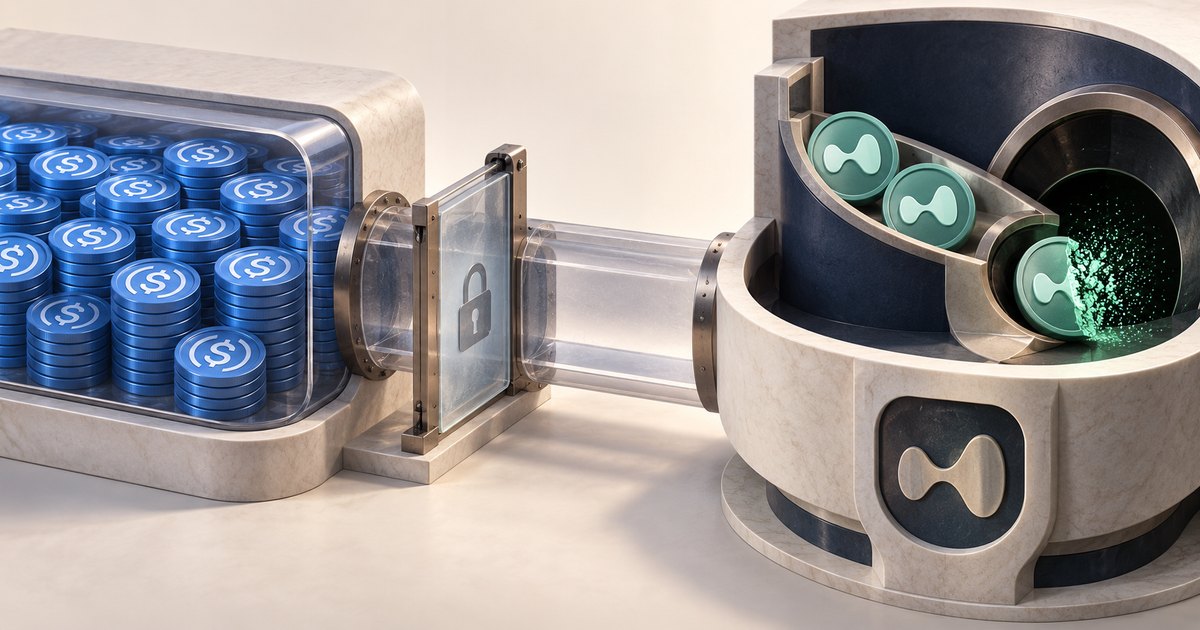
Under AQAv2, about 90% of the net yield generated on Hyperliquid's USDC reserves is routed to the Assistance Fund, Crypto Briefing reported. Validators approved the framework on June 12, 2026, with 69.08% support, per the outlet's account. Yield started accruing on August 26, and the pending payment covers that first stretch of accumulation. It landed close to the roughly $15 million the market had been anticipating.
LeoDex News couldn't independently verify the on-chain transfer, and it's still pending (so none of this USDC yield has gone into buybacks yet).
Coinbase serves as the official USDC treasury deployer, while Circle handles technical deployments, according to Crypto Briefing. The setup runs under a 1:9 technical-to-treasury balance requirement.
The bigger buyback math
Crypto Briefing estimated Hyperliquid's USDC reserves at between $5 billion and $6.7 billion. At prevailing yields of about 3%, the outlet projected annual buyback funding of $135 million to $200 million from reserves.
That's the smaller lever.
Approximately 99% of Hyperliquid's trading fees already flow into the Assistance Fund, and Crypto Briefing put annual fee-based buyback capacity at around $771 million. Add the USDC yield and the outlet's estimate for total annual buyback capacity tops $900 million. The fund has acquired approximately 45 million HYPE for around $1.1 billion, per the same report.
Why stablecoin yield is different
Perpetuals (or perps) are futures contracts with no expiry date, letting traders hold leveraged positions indefinitely. Stablecoin deposits tend to stick around even when trading slows, Crypto Briefing noted, because traders often keep collateral parked on the exchange between positions.
There's a trade-off, though. The framework ties a piece of HYPE's tokenomics to the operational health and policies of Coinbase and Circle, two centralized firms, as Crypto Briefing pointed out. For a defi exchange built on its own chain, that's a dependency worth watching as the first payment moves from pending to settled.
Frequently asked questions
How does Hyperliquid's AQAv2 framework fund HYPE buybacks?
Under AQAv2, about 90% of the net yield on Hyperliquid's USDC reserves is routed to the Assistance Fund, according to Crypto Briefing. The fund uses that money to buy HYPE on the open market and burn it. Yield began accruing on August 26, 2026.
Has the first AQAv2 yield payment been used for buybacks yet?
No. Crypto Briefing reported that the first payment, about $14.58 million in USDC, was still pending transfer to the Assistance Fund as of October 3, 2026. LeoDex News couldn't independently verify the on-chain transfer.
What role do Coinbase and Circle play in Hyperliquid's USDC yield?
According to Crypto Briefing, Coinbase serves as the official USDC treasury deployer and Circle handles technical deployments, under a 1:9 technical-to-treasury balance requirement. The outlet noted this ties part of HYPE's tokenomics to the health and policies of those two centralized firms.