Qatar posts widest quarterly budget deficit in nearly a decade as LNG exports collapse
In brief
- Qatar's Q2 budget deficit reached $5.8 billion, largest quarterly shortfall since late 2016.
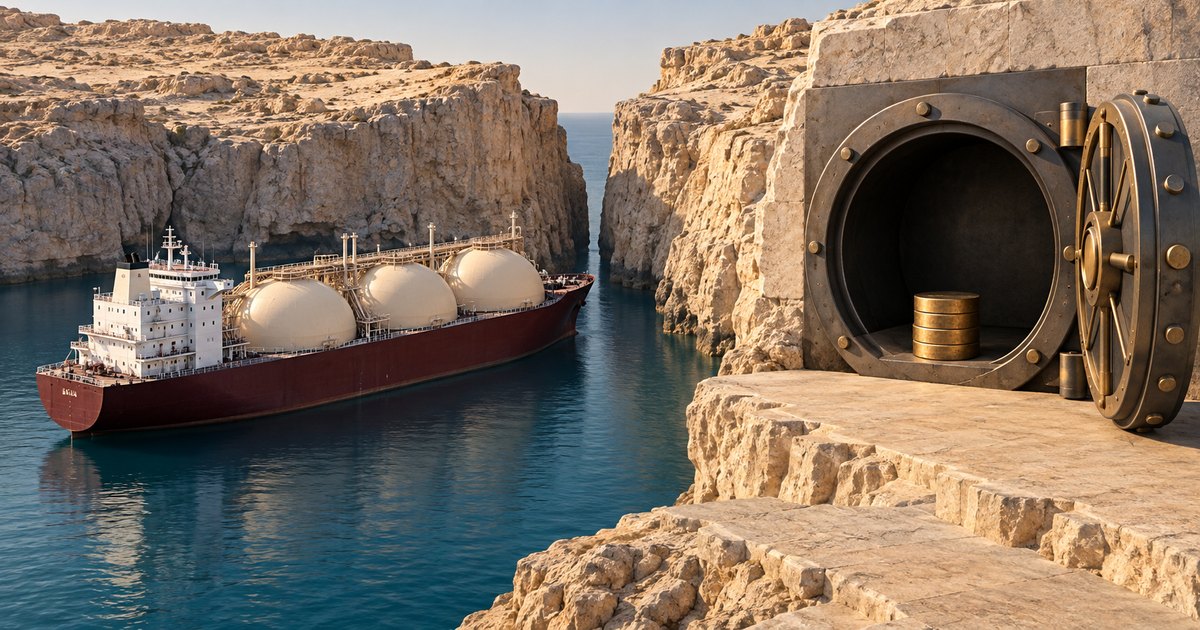
- LNG exports plummeted 90 percent after Strait of Hormuz disruptions halted shipping.
- First-half deficit of $11.5 billion already exceeds full-year budget projection.
- Energy revenue comprises 80 percent of Qatar's government income.
- Economists project 5-8 percent economic contraction for 2026.
The Export Shock
Quarterly LNG exports plummeted from approximately 20 million tons to less than 2 million tons, a decline exceeding 90 percent. The second-quarter deficit was nearly double the first-quarter shortfall of 10.3 billion riyals ($2.83 billion). Combined, the first half of 2026 produced a cumulative shortfall of 31.5 billion riyals, a figure that already surpasses the country's full-year budget projection of 21.8 billion riyals.
Total Q2 revenues came in at approximately 25.6 billion riyals, while expenditures held steady at approximately 46.8 to 46.9 billion riyals. The gap reflects Qatar's acute vulnerability to supply-chain shocks. Energy accounts for roughly 80 percent of Qatar's government revenue, making the export disruption existential rather than merely cyclical.
Geographic Risk and Diversification
Qatar's predicament exposes a structural weakness its Gulf neighbors have already hedged. Saudi Arabia can route crude oil west through Red Sea terminals, and the UAE completed the Habshan-Fujairah pipeline to bypass the Strait of Hormuz entirely. Qatar, by contrast, routes the vast majority of its LNG tankers through that narrow waterway.
Qatar is one of the world's top three LNG exporters alongside the US and Australia. Its North Field, the world's largest natural gas reservoir, feeds processing plants on the country's northeastern coast. The North Field expansion project was expected to boost the country's LNG capacity from 77 million tons per year to 126 million tons by the end of the decade. That trajectory now depends on sustained shipping stability.
Revenue Pressures and Fiscal Buffers
Non-energy revenues did provide some cushion, rising nearly five-fold on a quarter-over-quarter basis. Still, the country's full-year budget was built on a conservative oil price assumption of $55 per barrel. Economists now project an economic contraction of between 5 percent and more than 8 percent for full-year 2026.
Historically, Qatar has addressed budget shortfalls through sovereign debt issuance and drawdowns from its sovereign wealth reserves. The Qatar Investment Authority manages one of the world's largest sovereign wealth funds, providing a significant buffer. Yet even deep reserves cannot indefinitely absorb deficits of this magnitude.
Fitch Ratings removed Qatar from its negative watch status in September 2026, citing a reduced risk of further damage to LNG production facilities. The reprieve reflects optimism about Strait of Hormuz stability rather than a resolution of Qatar's underlying export concentration.