Sabi raises $50M for EEG beanie that turns thoughts into AI prompts
In brief
- Sabi announced a $50 million funding round on October 9, 2026, Crypto Briefing reported.
- Sabi's device is a beanie lined with miniature EEG sensors, not a brain implant.
- Sabi claims 70,000 to 100,000 sensors and decoding of around 30 words per minute.
- Khosla Ventures, Accel, Initialized Capital, DST Global and ex-OpenAI CPO Kevin Weil participated.
- Sabi says it plans to ship the product by the end of 2026.
A beanie, not an implant
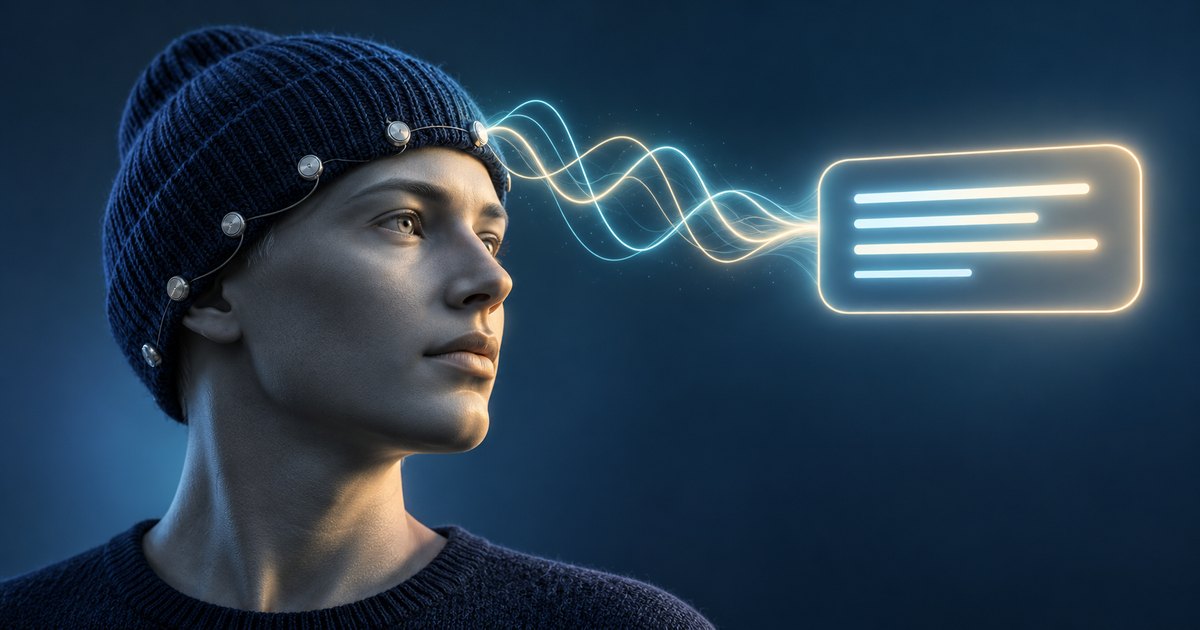
Sabi's flagship product is a beanie embedded with dense arrays of miniature EEG sensors. EEG reads the brain's electrical activity from outside the skull, so nothing gets implanted. The company says the beanie packs between 70,000 and 100,000 sensors, each about 1 mm in size.
Why so many?
Crypto Briefing noted that reading the brain through the skull is harder than reading it from the inside, and that's exactly why Sabi is stacking so many sensors and leaning on a large AI model. The stated goal is to decode internal thoughts into digital text or commands, and Sabi puts its estimated decoding speed at around 30 words per minute (that figure is the company's own estimate). A baseball cap variant is also in the pipeline, pitched as a more discreet option.
Where the $50 million goes
The investor list includes Khosla Ventures, Accel, Initialized Capital and DST Global, and Kevin Weil (a former chief product officer at OpenAI) also took part. Sabi plans to put the capital toward improving its hardware capabilities. It also plans to develop a proprietary "Brain Foundation Model", a large AI model trained to understand brain signals.
Sabi says that model is built on a dataset of approximately 100,000 hours of data collected from around 100 volunteers. The company calls it the world's largest neural decoding dataset, though that's Sabi's description, not an outside assessment.
Timeline and positioning
Sabi was founded around 2023 and emerged from stealth around April 16, 2026, with plans to bring brain-computer interfaces into the consumer wearable market. It's positioning itself directly against surgical brain-computer interfaces like Neuralink, which require invasive procedures. On privacy, Sabi says it's emphasizing end-to-end encryption and has made commitments to external audits.
Sabi says it expects to ship the product by the end of 2026. That's less than three months after the funding announcement.
Frequently asked questions
How does Sabi's brain-computer interface work without an implant?
Sabi's device is a beanie lined with dense arrays of miniature EEG sensors. EEG reads the brain's electrical activity from outside the skull, so nothing gets implanted. Sabi says the beanie holds between 70,000 and 100,000 sensors, each about 1 mm in size.
How fast can Sabi's device decode thoughts into text?
Sabi estimates its decoding speed at around 30 words per minute. The company's stated goal is to decode internal thoughts into digital text or commands. The speed figure is Sabi's own estimate.
What is Sabi's Brain Foundation Model?
It's a proprietary large AI model that Sabi plans to develop to understand brain signals. Sabi says it's built on approximately 100,000 hours of data collected from around 100 volunteers, which the company calls the world's largest neural decoding dataset.
When does Sabi plan to ship its EEG beanie?
Sabi says it expects to ship the product by the end of 2026. The company was founded around 2023 and emerged from stealth around April 16, 2026. A more discreet baseball cap version is also in the pipeline.