Skild AI's S1 robot masters football via 140 years of simulated self-play
In brief
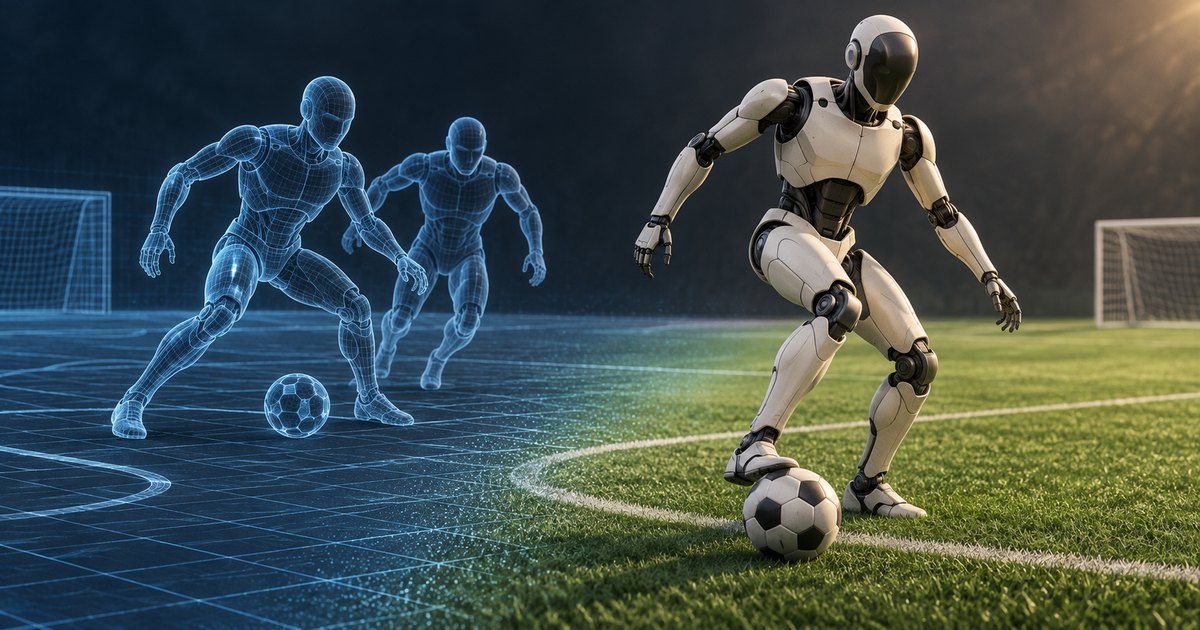
- S1 model trained entirely in NVIDIA Isaac Sim using self-play, with no human guidance or task-specific rewards.
- Football skills transferred directly to real-world scenarios without retraining or fine-tuning.
- Skild AI reached $100M ARR and $14B valuation after Series C funding in January 2026.
Training Without Human Guidance
The training approach stripped away conventional robotics scaffolding. The S1 model's training focused on a single objective: score goals, with no tailored rewards, task-specific demonstrations, or human trainer guidance. This mirrors the methodology DeepMind used to create AlphaGo and AlphaZero, systems that mastered board games by competing against copies of themselves.
The efficiency gains come from hardware scale. Modern GPU clusters can run thousands of parallel simulated environments simultaneously, compressing what would be over a century of real-time experience into a fraction of that in wall-clock time. NVIDIA's Isaac Sim provides the physics engine and rendering pipeline that makes this feasible at scale.
Versatility Beyond the Demo
Football is the flashy demo. The real commercial value lies elsewhere.
The S1 can perform complex manipulation tasks lasting up to 10 minutes from a single video demonstration. No fine-tuning. No parameter updates. The company has demonstrated the S1 performing tasks ranging from pancake flipping to kit assembly.
This generality reflects Skild AI's development philosophy, which draws explicit parallels to large language models, training on extensive data from human videos and physics simulations. The approach treats robotics as a scaling problem, not a per-task engineering exercise.
Commercial Traction
Skild raised $1.4 billion in a Series C funding round in January 2026, achieving a valuation exceeding $14 billion. SoftBank and NVIDIA participated in the round.
Its robots currently operate across more than 60 client companies. Skild reached a $100 million annual recurring revenue run rate shortly after its first commercial deployment earlier in 2026. ABB Robotics and Teradyne, which owns Universal Robots and MiR, are both working with Skild. The company has also deployed robots assembling NVIDIA Blackwell GPU systems at Foxconn.
Launched in late August 2026, the S1 represents a shift in how industrial robotics scale. Rather than hand-coding behaviors for each task, Skild's approach trains a single model on diverse data, then deploys it across use cases. The football demo proves the model can learn complex, dynamic coordination. The real test is whether that versatility holds across the 60-plus deployments now running in production.
Frequently asked questions
How did Skild AI train a robot to play football?
The S1 model trained entirely in NVIDIA Isaac Sim using self-play—competing against copies of itself. The training focused on a single objective: score goals, with no human guidance, task-specific rewards, or demonstrations. Modern GPU clusters compressed the equivalent of 140 years of real-time experience into weeks.
Did the robot need retraining to play football in the real world?
No. The policy learned entirely in simulation transferred directly to real-world scenarios. The robot can now play football against both humans and other robots without any additional fine-tuning or task-specific training.
What other tasks can the S1 model perform?
The S1 can perform complex manipulation tasks lasting up to 10 minutes from a single video demonstration, including pancake flipping and kit assembly. It requires no fine-tuning or parameter updates between tasks, reflecting a general-purpose training approach similar to large language models.