Google DeepMind says AI agents built dancing robot from one text prompt
In brief
- Google DeepMind showed a physical dancing robot on October 31, 2026, Crypto Briefing reported.
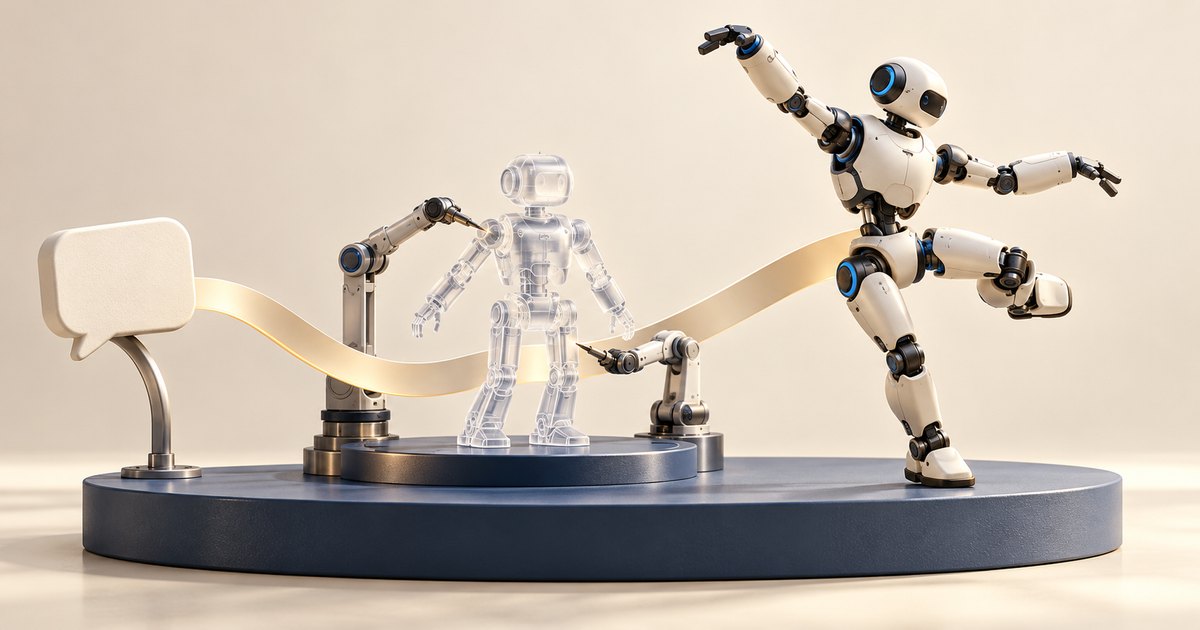
- AI agents designed, simulated and built the robot from one plain-English prompt, DeepMind said.
- The robot has 12 degrees of freedom and a Halloween theme.
- The work relied on the Gemini 4 Argon model and the Antigravity development platform.
- Aaron Saunders, former Boston Dynamics engineering VP, led the project, per the report.
What DeepMind says the agents did
The pitch is simple: type a description, and the agents take it from there.
DeepMind said AI agents handled the project end-to-end, going from a text description to a design, then through simulation and on to a physical build. A degree of freedom is one independent direction a machine can move. With 12 of them, the robot has 12 independent axes to work with. Because the demo fell on October 31, DeepMind gave it a Halloween theme.
These details are DeepMind's own account as relayed by Crypto Briefing (they haven't been independently checked).
The two tools behind it
The report named two pieces of technology. The first is Gemini 4 Argon, a model announced in late September 2026 and released broadly in mid-October. It's built for complex reasoning that runs across many steps, with a particular focus on robotics simulation and on generating accurate representations from video inputs.
The second is Antigravity, a development platform DeepMind launched in 2025 for autonomous coding and for orchestrating work across multiple systems.
Crypto Briefing said the research describes a move toward "agent-first" environments in robotics, where AI agents are the primary operators and humans take a supervisory role.
Who led it, and what came before
Aaron Saunders led the project, according to Crypto Briefing, after previously serving as VP of Engineering at Boston Dynamics.
This isn't DeepMind's first robotics project. In September 2025 the lab introduced RoboBallet, a system meant to improve how collaborative robots work together in manufacturing settings. RoboBallet was about coordination (getting multiple machines to share a workspace efficiently). The new demo takes on a different problem: hardware design, which the report called one of the most labor-intensive parts of building a robot.
Outside developers are only now starting to test the model DeepMind used here, since Gemini 4 Argon has been broadly available only since mid-October 2026.
Frequently asked questions
What is a degree of freedom in robotics?
A degree of freedom is one independent direction a machine can move. DeepMind's dancing robot has 12 degrees of freedom, according to Crypto Briefing's report on the October 31, 2026 demo.
What technology did DeepMind use to build the dancing robot?
Crypto Briefing named two tools. Gemini 4 Argon is a model announced in late September 2026 and built for multi-step reasoning, with a focus on robotics simulation. Antigravity is a development platform DeepMind launched in 2025 for autonomous coding and for orchestrating work across multiple systems.