Ratepayer Protection Act fails Senate vote as data center grid cost fight grows

In brief
- 57 Senate votes backed the bill, three short of 60, per Colbert's CoinDesk op-ed.
- House lawmakers passed the Ratepayer Protection Act 417–3, according to the op-ed.
- Computing facilities with peak demand of at least 100 megawatts were the bill's target.
- Colbert expects a wider push to regulate digital infrastructure and the AI stack.
What the bill would have done
According to Colbert's CoinDesk op-ed, 57 senators voted to advance the measure and 43 opposed. He wrote that the House had passed the same bill by a vote of 417–3.
The Senate tally fell short of the 60 votes it needed.
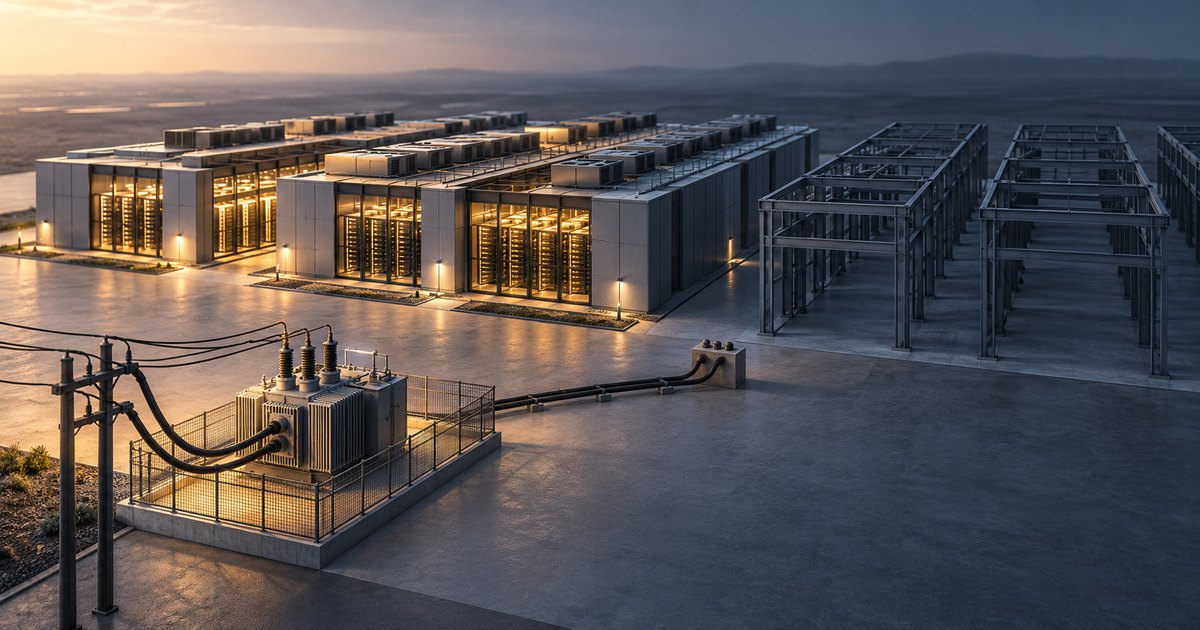
Sen. Jon Husted (R-Ohio) and Reps. Gabe Evans (R-Colo.) and Kathy Castor (D-Fla.) championed the bill. It would've required state utility regulators and certain utilities to consider standards under which computing facilities with peak demand of at least 100 megawatts cover full incremental power generation and grid upgrade costs. States would've kept the authority to decide whether to adopt them (the bill asked them to consider the standards, nothing more). Colbert wrote that Senate debate centered on whether that went far enough.
The pledge already on the table
Colbert points out that earlier this year the president and leaders of major tech companies agreed on the same cost principle through the Ratepayer Protection Pledge. Per the op-ed, Amazon, Google, Meta, Microsoft, OpenAI, Oracle and xAI committed to covering the costs of new power generation required for their data centers. In July, he wrote, the White House announced an expansion that brought over 200 additional utilities, data center developers, cooperatives and states into the effort.
In Colbert's view, Congress now has to work out how public policy should give those commitments effect. He doesn't treat the Senate vote as a conclusion.
This isn't the end of the story for this policy idea. It is the beginning of a trend that will characterize the end of this year and the next Congress: the push to regulate every layer of the digital infrastructure and AI stack.
Colbert's case for what comes next
Colbert's argument rests on a basic expectation. Large new loads should account for the infrastructure required to serve them, he wrote, with costs and risks made clear before projects move forward.
He also argues that deciding who pays won't fix everything. Faster development of generation, transmission, storage and equipment could ease constraints that cost allocation alone can't solve, according to Colbert. Those are his recommendations as an industry advocate, and the next Congress hasn't settled any of them.
Frequently asked questions
What would the Ratepayer Protection Act have done?
According to Rashan Colbert's CoinDesk op-ed, the bill would have required state utility regulators and certain utilities to consider standards under which computing facilities with peak demand of at least 100 megawatts cover full incremental generation and grid upgrade costs. States would have kept the authority to decide whether to adopt those standards.
Why did the Ratepayer Protection Act fail in the Senate?
Colbert's op-ed says 57 senators voted to advance the measure and 43 opposed, short of the 60 votes needed to move forward. He wrote that Senate debate centered on whether asking states only to consider a cost recovery standard went far enough.
What is the Ratepayer Protection Pledge?
Per Colbert's op-ed, it's an agreement between the president and leaders of major technology companies on the principle that data centers cover their own power costs. Amazon, Google, Meta, Microsoft, OpenAI, Oracle and xAI committed to covering the costs of new power generation for their data centers, and a July White House expansion added over 200 more participants.