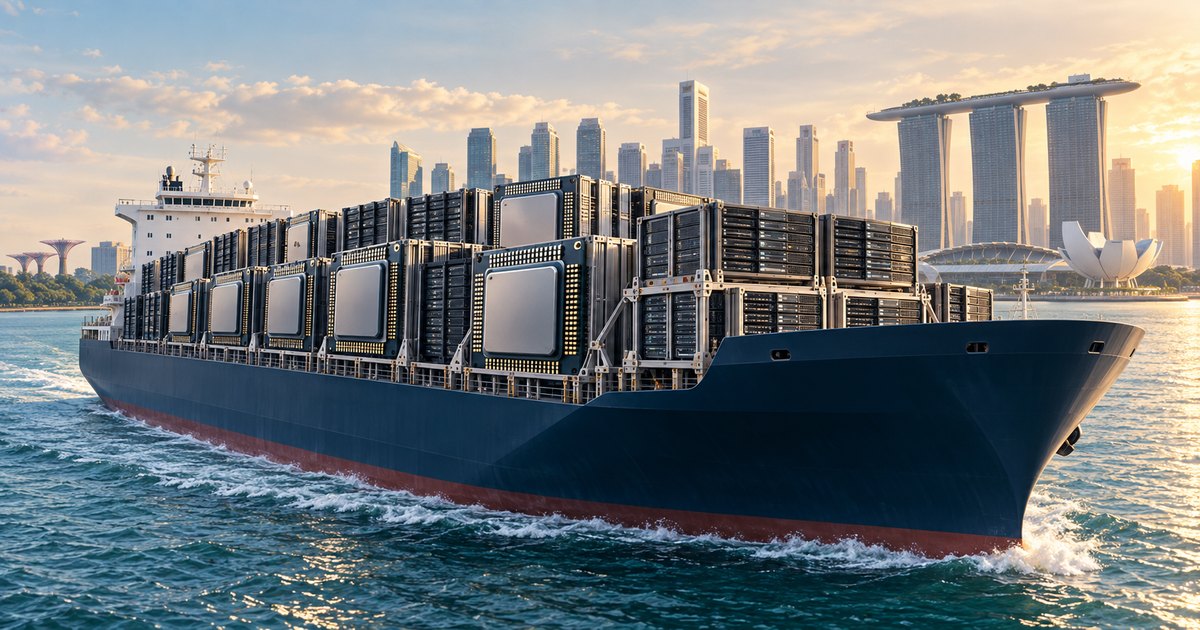
South Korea's $518B AI chip push widens crypto's capital deficit
In brief
- Samsung and SK Hynix commit $518 billion to build four new chip plants in South Korea, doubling DRAM output over five years.
- AI demand could accelerate completion to 2034–2035, over a decade ahead of the original 2044 target.
- SK Hynix raised roughly $29 billion in a U.S. stock listing and became South Korea's most valuable listed company.
- AI infrastructure capital spending competes directly with crypto for investor capital and risk appetite.
- Bitcoin miners are redirecting computing capacity toward AI hosting, where contracted payments exceed mining revenue.
The AI Memory Play
High-bandwidth memory, or HBM, is the specialized chips that feed AI training and the large language models behind chatbots like ChatGPT and Claude. Samsung and SK Hynix together supply most of the world's HBM and have struck supply deals with Nvidia and OpenAI. The two firms' dominance in this space has transformed their market position. SK Hynix became South Korea's most valuable listed company this month, passing Samsung for the first time in 25 years.
Funding the expansion, SK Hynix separately announced plans for a roughly $29 billion U.S. stock listing, among the largest ever. The sheer scale of these commitments signals confidence that AI infrastructure demand isn't a cycle—it's structural.
Crypto's Shrinking Slice
The capital flooding into AI chips is a direct headwind for crypto. Gabe Selby of CF Benchmarks said in a statement that "much of the new money and attention has flowed into AI plays, leaving crypto fighting for a smaller share of overall risk appetite." When gold, silver and bitcoin sold off together in recent weeks as a hedge trade unwound, the cash leaving those hard assets moved into AI stocks rather than into bitcoin.
Even bitcoin miners have been redirecting computing capacity toward AI hosting, where contracted payments beat the swings of mining revenue. It's a telling sign of where capital and talent see the structural opportunity.
The Decade Bet
South Korea's $518 billion commitment is a decade-long bet that AI infrastructure spending is structural rather than a passing boom. Meanwhile, Bitcoin is near to closing the first half of 2026 below $60,000 and sitting near its 200-week moving average. The divergence in capital allocation couldn't be clearer. South Korea's government and its largest chip makers are betting trillions on AI infrastructure while crypto remains caught between retail interest and institutional skepticism.
Frequently asked questions
Why are Samsung and SK Hynix accelerating their chip-plant buildout?
AI demand for high-bandwidth memory (HBM) is forcing the companies to finish construction by 2034–2035, more than a decade ahead of the original 2044 target. HBM is the specialized memory that powers AI training and large language models.
How does AI chip spending affect crypto?
The capital cycle funding AI infrastructure competes directly with digital assets for investor money. When hedge trades unwound recently, cash from gold, silver, and bitcoin flowed into AI stocks rather than back into crypto, leaving digital assets fighting for a smaller share of overall risk appetite.
What's SK Hynix's plan to fund further expansion?
SK Hynix announced a roughly $29 billion U.S. stock listing, among the largest ever. The offering will help fund the company's expansion as it capitalizes on AI memory demand.