Cardano slashes minimum pool fee to 75 ADA, but delegators benefit only if pools comply
In brief
- Cardano governance action proposes cutting minimum pool cost from 170 ADA to 75 ADA
- Proposal requires 67% DRep approval and 66.7% Constitutional Committee support
- Delegators benefit only if pools voluntarily lower fees; operators can maintain higher charges
- Earlier Plutus-based version failed to gain sufficient stake pool operator support
How the fee cut works
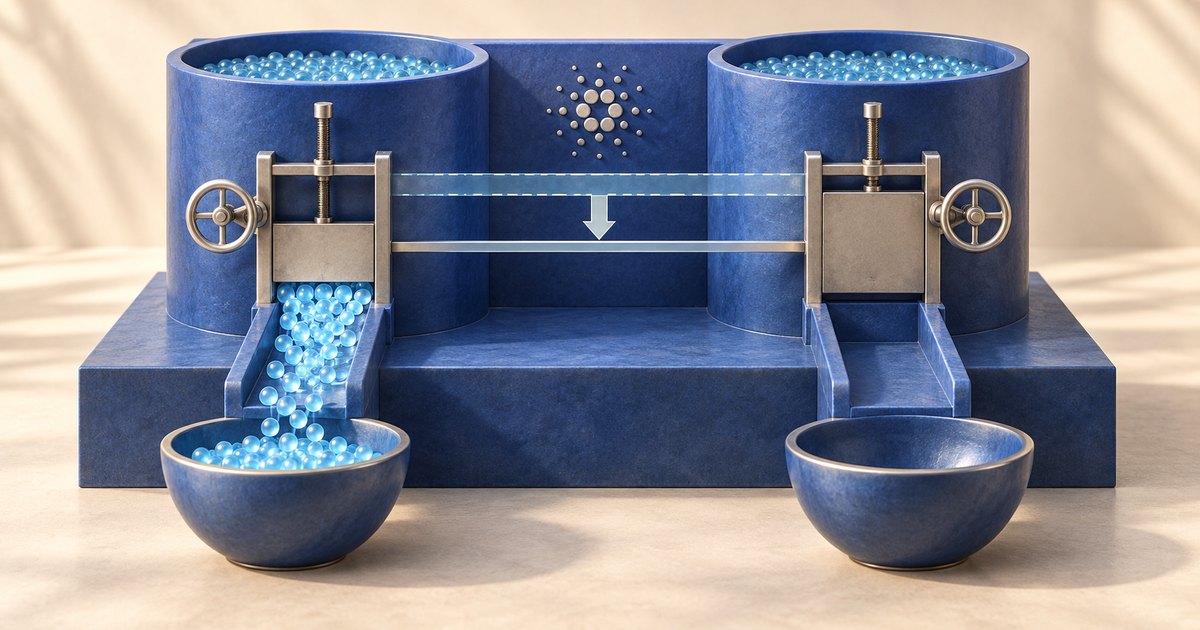
A pool's fixed cost is taken from its gross reward each epoch before its margin. For a small pool earning 300 ADA from a single block, the current 170 ADA minimum cost claims about 57% of that reward before the operator's margin applies. If the proposal passes, that share drops to 25% — but only if the operator declares and enforces the lower fee.
If the proposal passes, an operator could declare 75 ADA, continue charging 170 ADA, or keep a higher fee. There's no mandate. That flexibility is the real tension.
"Delegators receive a benefit only if a pool with rewards to share actually lowers its charge."
Why this version exists
The standalone proposal was submitted on September 11 and changes only the minPoolCost parameter. An earlier action expired on September 1 after DRep yes votes reached 68.6%, above the 67% threshold — but stake pool operator support reached only 34.5% of counted stake, short of the required 51%. The earlier version included a Plutus memory-limit change that brought pools into opposition.
This time, the proposal changes only minPoolCost, which requires DRep and Constitutional Committee approval but no stake pool operator ballot. That narrower scope removes the pool veto — but it also means pool operators have no incentive to support the cut.
The vote so far
As of September 23, yes votes represented 11.7% of counted DRep stake, well short of the 67% threshold. Two of seven committee members had voted yes, or 28.6%, against a 66.7% threshold. Voting ends in epoch 661 on October 11.
The pool economics problem
Cardano lowered the minimum from 340 to 170 ADA in October 2023. Yet an Input Output Research study found that 340 ADA was still the most common declared fixed cost across active pool sizes. The 170 ADA fee became a second tier used by smaller challengers. That pattern suggests operators resist cutting fees even when rules allow it. A 75 ADA floor may face the same resistance. The study classified 627 active pools in a struggling category below viability benchmarks, alongside 246 viable small pools and 741 pools at or above 3 million ADA.