South Korea doubles chip production goal with $520B Samsung, SK hynix investment
In brief
- South Korea targets semiconductor production doubling within five years under President Lee's plan
- Samsung Electronics and SK hynix commit $520 billion for four new memory fabrication plants
- New facilities expand into Honam, Gwangju, and Chungcheong regions to ease capacity constraints
- Samsung and SK hynix control approximately two-thirds of global memory chip production
The Investment Plan
Samsung Electronics and SK hynix committed a combined investment exceeding 800 trillion won, approximately $520 billion, to fuel the expansion. The two firms already account for about two-thirds of global memory chip production, making their commitment central to South Korea's strategy to expand its chip manufacturing footprint.
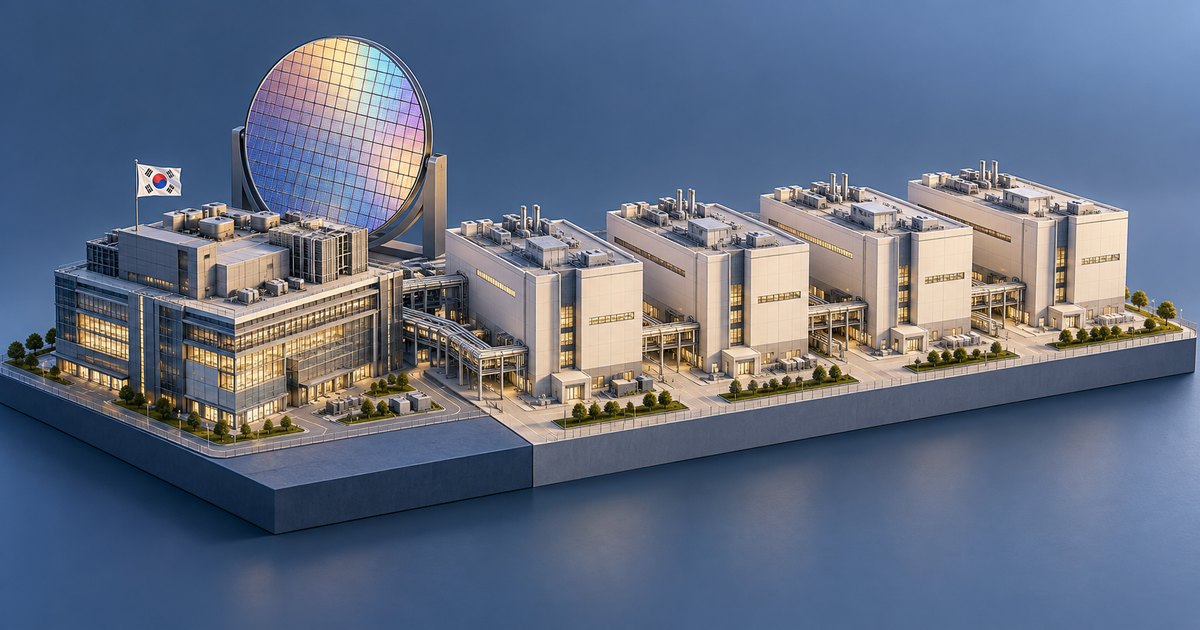
The investment is earmarked for four new memory fabrication plants, supplier networks, and the infrastructure needed to support them. This marks a significant capital deployment in response to growing global demand for semiconductors and South Korea's ambition to maintain its position as a leading chip manufacturer.
Geographic Expansion Beyond Seoul
New memory fabrication plants are planned for the Honam and Gwangju region, with a packaging hub slated for Chungcheong province. Existing production clusters in Yongin and Pyeongtaek, both south of Seoul, will see accelerated timelines.
The geographic diversification reflects a deliberate strategy. The Seoul metropolitan area is running into practical capacity limits where land is expensive, labor markets are tight, and zoning presents challenges. By routing new facilities into historically less-industrialized regions, the plan aims to both expand manufacturing and distribute economic activity across the country.
Broader Context
The semiconductor expansion is part of a larger initiative. The five-year target was first detailed on June 29, 2026, as part of three megaprojects focusing on semiconductors, physical AI, and AI data centers. Total investment is expected to surpass 880 trillion to 1 quadrillion won across all three megaprojects.
President Lee's framing underscores the national stakes. He referred to Samsung Chairman Lee Jae-yong and SK Group Chairman Chey Tae-won as "national heroes" for their investment commitments, signaling that the semiconductor expansion is viewed as critical infrastructure for South Korea's long-term competitiveness.
The plan reflects both opportunity and urgency: global chip demand continues to climb, supply-chain resilience remains a priority for tech-dependent economies, and South Korea's existing dominance in memory manufacturing positions it to capture significant market share if execution succeeds.